
What is RF MEMS Switch : Benefits & Top Manufacturers
Advertisement
An RF MEMS switch is a microelectromechanical switching device that controls RF signal paths with low loss, high isolation, and minimal power consumption. RF MEMS switches are increasingly used in satellite communications, test equipment, phased array antennas, and advanced wireless communication platforms.
Typical applications for these switches include switched filter banks, tunable filters, antenna tuning, RF front ends, switch matrices, and EM relays. RF switches can be broadly categorized into electro-mechanical and solid-state types.
MEMS stands for Microelectromechanical Systems. Solid-state switches utilize devices like PIN diodes, GaAs FETs, and silicon diodes in their construction.
What is an RF MEMS Switch?
RF MEMS switches are micromechanical switches designed to operate within the radio frequency (RF) range. They function similarly to a light switch, opening and closing a contact to allow or block signal transmission.
Due to their miniaturized mechanical components, RF MEMS switches are smaller in size and consume less power. The figure below illustrates the layout and block diagram of an RF MEMS Switch in an SP4T (Single-Pole, Four-Throw) configuration. Each of the four channels in this MEMS switch can be individually controlled by applying a gate voltage to its corresponding RF GATE pin.
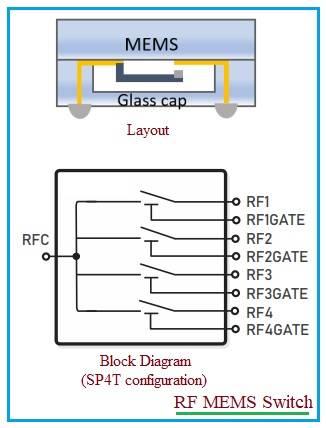
The following specifications are typically considered when selecting an RF MEMS Switch:
- Operating frequency range
- Function of the switch (e.g., SP4T, SPST, DPDT)
- Insertion loss (in dB)
- IP3 (Third Order Intercept Point)
- On-State Resistance ()
- Off-State Capacitance ()
- Isolation (in dB)
- Power (CW - Continuous Wave)
- Switching speed
- Lifetime (in number of cycles)
- Controller (Direct drive, serial to parallel, SPI, GPIO)
- Input voltage
- Packaging type (BGA, LGA, WL-CSP)
Benefits or Advantages of RF MEMS Switches
Here are the key advantages of using RF MEMS switches:
- Fast Switching Time: They offer quick switching speeds.
- Low Insertion Loss: They minimize signal loss during transmission.
- High Isolation: They provide excellent isolation between signal paths.
- High Power Handling: They can handle relatively high incident RF power.
- Small Size and Lightweight: They integrate mechanical and electrical components at a micro-scale, making them compact and lightweight. They are also cost-effective due to large-volume production capabilities.
- Low Power Consumption: They consume very little power.
- High ESD Immunity: They offer enhanced protection against electrostatic discharge.
- Robust Performance: RF MEMS switches deliver superior RF performance under extreme conditions, including harsh temperatures, vibration, shock, and RF power.
- Improved Robustness: RF MEMS switches are generally more robust compared to other switching technologies.
RF MEMS Switch Manufacturers or Vendors
The following table lists some prominent manufacturers and vendors of RF MEMS switches:
| Manufacturers | Description |
|---|---|
| Menlo Microsystems, Inc. | Offers MM5000 series switches, including MM5130 (SP4T), MM5600 (DPDT), MM5120 (SP4T), etc. Website: menlomicro.com Email: sales@menlomicro.com |
| Coventor Inc. | Develops various MEMS-based devices, including accelerometers, gyroscopes, actuators, magnetometers, microphones, micro-bolometers, energy harvesters, RF switches, and optical MEMS devices. Website: coventor.com |
| Analog Devices, Inc. | Provides RF MEMS switches ranging from DC to 14 GHz, known for excellent reliability, superior precision, and better performance. Website: analog.com |
| Omron Electronics | Develops RF MEMS switches in various frequency bands with different structures and configurations. Website: Omron.com |
| Bright Toward Industrial Co., LTD., Taiwan | Offers multi-channel RF MEMS switches in various frequency bands (e.g., 3 GHz, 12 GHz, 26 GHz). These switches support low loss, high power, low power consumption, high reliability, and fast switching. Website: relay.com.tw |
Summary
RF MEMS switches provide low-loss RF signal switching for communication and radar systems. Leading manufacturers develop MEMS switches for satellite, aerospace, defense, and high-frequency wireless applications.
Advertisement


