
What are Deep Learning Tools : Top Software Companies
Advertisement
Deep learning tools are software platforms, frameworks, and development environments that help organizations build, train, deploy, and manage artificial intelligence models based on neural networks. These tools simplify data processing, model development, automation, and scalability, enabling businesses and researchers to create advanced applications in computer vision, natural language processing, speech recognition and predictive analytics.
What is Deep Learning? - An Introduction
- Machine Learning: Extracts image features (corners, edges) to create object models, which are then used for identification. Machine learning doesn’t demand high-performance processors or extensive datasets.
- Deep Learning: A subtype of machine learning where features and tasks are learned directly from data (images, text, audio).
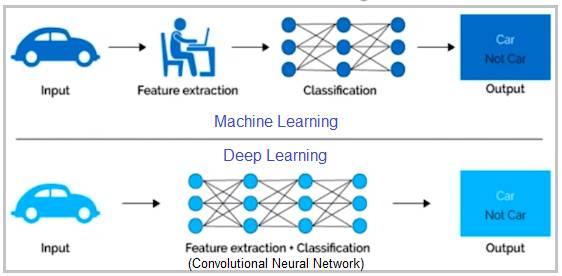
Figure-1: Machine Learning Vs Deep Learning
Deep learning algorithms, specifically convolutional neural networks (CNNs), handle feature extraction and classification. Deep Learning thrives on large datasets and benefits from high-performance GPUs.
List of Best Deep Learning Tools | Deep Learning Software Vendors
Table 1 below presents a list of top deep learning tools.
Selecting the right tool hinges on the specific problem and the type of data involved. This list of deep learning software vendors can help choose the right tool or software for your application.
Table 1: Deep Learning Tools and Their Features
| Deep Learning Tools | Description with features |
|---|---|
| TensorFlow | Consists of TensorBoard (Data Visualization) and TensorFlow Serving (New algorithm development). |
| PyTorch | Runs on Python. Employs CUDA with C and C++ libraries. |
| Keras | Supports convolution and recurrent networks. Integrated with TensorFlow. Main uses: classification, tagging, translation, speech recognition, text generation/summarization. |
| Theano | Developed by MILA lab at the University of Montreal. A CPU/GPU symbolic expression compiler in Python. |
| Pylearn2 | A library designed for research in machine learning. |
| Caffe | A framework with expression, speed, and modularity in mind. Developed by BAIR (Berkeley AI Research) and other community contributors. Released under a BSD 2-clause license. |
| MXNet | Rich in language bindings. Works with Python, Scala, R, Perl, Julia, Matlab, C++, and Javascript. Highly scalable for a variety of devices. |
| H2O | Developed by Mountain View company (H20.ai). Released under Apache 2.0 open source license. Written in Java, Python, and R. |
| Microsoft Cognitive Toolkit (CNTK) | Handles multi-dimensional dense or sparse data from Python, C++, or BrainScript. A deep learning framework developed by Microsoft Research. |
| Torch | An open-source machine learning library. A scientific computing framework. Uses LuaJIT scripting language with underlying ‘C’ implementation. Provides a wide range of deep learning algorithms. |
| Chainer | An open-source deep learning framework. Written purely in Python on top of Numpy and CuPy Python libraries. Development led by “Preferred Networks” with IBM, Intel, Microsoft, and Nvidia. |
| Neural Designer | Used for data analytics with a GUI for easier data entry and result interpretation. Written in C++ by Artificial Intelligence Techniques, Ltd. |
| BigDL | A distributed deep learning framework for Apache Spark. Created by Jason Dai at Intel and hosted on GitHub. |
| OpenNN | A C++ library implementing neural networks. Open-source and licensed under the GNU. |
| RapidMiner | Provides an integrated environment for data preparation, machine learning, deep learning, text mining, and predictive analytics. Written in Java. |
| XGBoost | An open-source software library providing a gradient boosting framework for C++, Java, Python, R, and Julia. Works on Linux, Windows, and macOS. |
Summary
Deep learning tools are software solutions used to develop and deploy neural network-based AI models. Leading deep learning software companies provide frameworks and platforms that support machine learning workflows, model training, data analysis, automation and large scale AI application development across industries.
Advertisement


