
What is VoLTE: Voice Over LTE Advantages and Disadvantages
Advertisement
Voice over LTE (VoLTE) is a mobile communication technology that delivers voice calls over 4G LTE networks using IP-based transmission. Its advantages include HD voice quality and faster call connection, whereas its disadvantages include LTE network dependence and device compatibility requirements.
VoLTE using VOIP through IMS Block Diagram
LTE is an all-IP network designed primarily for internet/data applications. To support voice over LTE networks, there are two main options: using IMS (VoIP) and circuit-switched legacy fallback on 2G/3G.
VoLTE is essentially HD voice calling service over a 4G/LTE network, rather than relying on older 2G/3G networks.
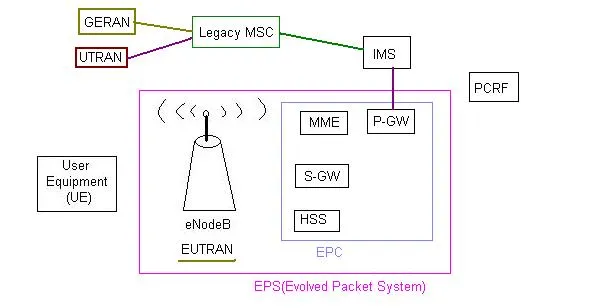
VoLTE using IMS (VOIP)
- If it’s a VoIP to VoIP call, it remains within the LTE network and is supported using VoIP protocols.
- However, if it’s a VoIP to CS call for a GSM/WCDMA network, IMS, with the help of application servers and legacy MSC, transfers the PS call to legacy networks (2G-GERAN/3G-UTRAN).
- If it’s a VoIP to PSTN call, IMS directs the call through a PSTN interface to the appropriate exchanges.
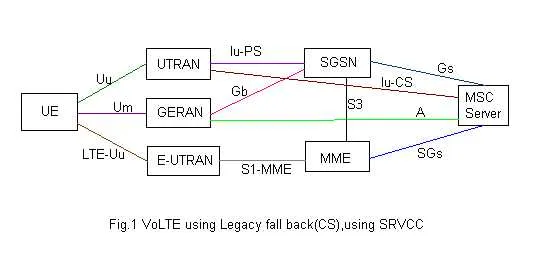
VoLTE using 2G/3G CSFB (using SRVCC)
- When a UE (User Equipment) moves from an LTE network to legacy networks (GSM/WCDMA), a handover is performed based on measurement reports submitted by the UE. This transfers the Voice over IP call to a legacy voice call.
Advantages of VoLTE (Voice over LTE)
- It delivers all voice and data services over the same network. Hence, there’s no need to maintain legacy infrastructure.
- VoLTE makes calls much faster compared to 2G/3G voice calls.
- It offers better security and QoS (Quality of Service) compared to legacy 2G/3G networks.
- It extends the battery life of smartphones. This is due to the use of shorter DRx (Discontinuous Reception), which results in improved device power efficiency.
- It increases the functionalities of VoIP protocols.
- It offers improvement in capacity using RoHC/SPS protocols.
- It provides call continuity between packet-switched LTE networks and circuit-switched WCDMA networks using SVRCC (Single Radio Voice Call Continuity).
- It improves UL (Uplink) coverage using TTI (Transmission Time Interval) bundling.
- All the profiles are GSMA defined, making it compatible across the world. This leads to easy roaming and wider handset availability.
Disadvantages of VoLTE (Voice over LTE)
- It requires investment in a network-wide IMS. Hence, this will not be available everywhere, and roaming could be a challenge for some time.
- If there is no data connection or 4G signaling in the area, the user will neither be able to make calls nor be able to use the internet using the handset.
- VoLTE should be supported by handsets in order to obtain VoLTE services. The VoLTE feature is not available in all mobile handsets.
- HD voice calls can only be made between two VoLTE-compliant handsets. If a VoLTE handset calls any other network-compliant handset, the standard call quality can be achieved, but not HD quality.
Summary
VoLTE improves mobile communication through clearer voice quality, faster call setup, and efficient utilization of LTE network resources.
Continue Learning VoLTE Fundamentals & Technology Comparisons
- VoLTE Basics and Types
- LTE vs VoLTE: Understanding the Differences
- VoNR (Voice over New Radio) vs VoLTE
- LTE to VoLTE Conversion