
UWB vs PIR vs mmWave Radar: Key differences
Advertisement
There are three main technologies used in presence detection application which include passive infrared (PIR), millimeter wave (mmwave) and ultra wideband (UWB). Before we explore differences between them, let us understand operating principle behind these technologies.
Passive Infrared (PIR) Sensors
This technology is used often in most smart home security alarms and automatic light switches. Let us understand its working.
- PIR is a thermal sensor. It does not emit signals. It only listens.
- It detects the infrared radiation (i.e. heat) emitted by warm body.
- As it uses segmented lens to break the room into zones, when any heat source moves from one zone to the another, the sensor trips.
Limitation: It requires Significant Motion. If you sit perfectly still on couch or sofa, a PIR sensor assumes the room is empty and turns off the lights. It also can not measure distance and is easily blocked by furniture (Line of Sight only).
Mmwave Radar (60-77 GHz)
mmWave is a high frequency radar often used in advanced automotive safety and high end building automation. Let us understand its working.
- It transmits radio waves at high frequencies (Frequency Modulated Continuous Wave - FMCW) continuously.
- It measures doppler shift of reflected waves.
Advantages:
- It is incredibly sensitive.
- It can detect the heartbeat of a person standing meters away.
- It offers high resolution point clouds, allowing it to distinguish between a person and a fan.
Limitations:
- It is power hungry and computationally expensive.
- It typically generates high heat and requires a constant power source (hard to run on coin cell batteries).
UWB Radar (3-10 GHz)
UWB bridges the gap between low power PIR and high intelligence of radar. Let us understand its working.
- It uses impulse radio. Instead of continuous wave, it shoots out chain of nano-second pulses.
- It measures both the time of flight (ToF) and micro-doppler changes in the pulses as they bounce back.
Advantages:
- It combines both ranging and sensing methods. It can tell where exactly the person is and whether he/she is alive based on breathing detection. It detects presence as well as breathing pattern.
- It consumes very little power (< 10 mWatts).
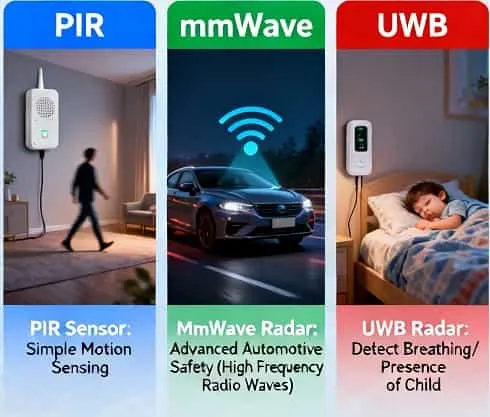
Difference between PIR Vs. MMwave Radar Vs. UWB Radar
| Feature | Passive IR (PIR) | Mmwave Radar | UWB Radar |
|---|---|---|---|
| Sensing Method | Thermal Change (Heat) | Electromagnetic (FMCW) | Periodic Impulse (ToF) |
| Detects Stationary People? | No | Yes (Detects breathing) | Yes (Detects breathing) |
| Power Consumption | Ultra low (Years on battery) | High (Often needs mains) | Low (Efficient Sensing) |
| Through Wall Sensing | No (Blocked by everything) | Yes (Depends on material) | Yes (Excellent penetration) |
| Distance measurement | None (Binary On/Off) | High accuracy | High Accuracy (~10 cm) |
| Interference immunity | Low | High | High, resists multipath |
| System Cost | Very Low | High | Medium |
Summary
The choice between the technologies depends on desired application.
- Choose PIR if you need cheapest solution for simple motion lighting
- Choose mmwave if you need extremely high resolution imaging with power source requirement such as wired security system.
- Choose UWB if you need a battery powered device that offers high precision, can see through obstacles (like blankets or drywalls), and needs to detect breathing/presence without false alarms.
Continue Learning UWB Technology
- UWB Basics Tutorial
- UWB Physical & MAC Layers
- UWB Frame Structure
- Understanding UWB Networks
- UWB Radar Tutorial
- UWB : Key Advantages & Disadvantages
- UWB Anchor Vs Tag : Key differences
Explore UWB Use Cases
- UWB based Automatic Parking System
- UWB based Child Presence Detection
- UWB based digital key for theft prevention
- UWB vs GPS for Warehouse Asset Tracking
Compare Radar With Other Technologies
- Radar Vs. LiDAR : Key Differences
- Radar Vs. SONAR : Key Differences
- Radar Vs. PIR Motion Sensors
- Radar Sensing Vs. Wi-Fi Sensing
Explore More Radar Types & their working
| AESA Radar Working & Benefits | AESA Vs. PESA Radar | Angle Vs. Monopulse Tracking Radars | ARSR and ASR Airport Surveillance Radar | Automotive Radar | Coherent Vs. Non-Coherent MTI Radar | CW Radar | Doppler Radar | FMCW Radar | Frequency Scanned Radar | Ground Penetrating Radar | HFSWR Radar for aircraft detection | Millimeter Wave Radar | Missile Seeker Radar | Monopulse & Conical Scan Radar | Monostatic & Bistatic Radar | MTI Radar | Over The Horizon Radar | Pulsed Radar | Search & Tracking Radar | Surveillance Radar | TWS Radar | UWB Radar | Weather Radar | X-Band Radar |
Continue Learning Radar Technology
- Radar Tutorial: Types and Applications
- Radar Architecture Components & Functions
- Radar Duplexers: Types and Functionality
- Radar Classifications or Types
- Radar : Key Advantages & Disadvantages
- Radar Frequency Bands Chart
- Radar - Transmitter & Receiver Measurements
- Active Radar Vs. Passive Radar : Key Differences
- Radar Terminologies