
What is Time of Flight (ToF) Camera: Advantages and Disadvantages
Advertisement
A Time of Flight (ToF) camera is a depth-sensing imaging system that measures the travel time of reflected light to determine object distance and create three-dimensional images. Its advantages include fast depth measurement, accurate distance estimation, and real-time operation, whereas its disadvantages include limited outdoor performance, higher cost, and sensitivity to reflective surfaces.
ToF Camera Sensor : Working operation and applications
ToF technology leverages 3D imaging using a low cost CMOS pixel array and a modulated light source. These cameras find applications in a wide range of areas, including:
- Gesturing
- Sensing
- Scanning
- Printing
- Gaming
- Home Entertainment
- Portable Computing
- Depth Measurement
These applications can be broadly categorized into gesture-based and non-gesture-based applications. Gesture applications translate human movements into commands for gaming consoles, smart TVs, and other computing devices. Non-gesture applications encompass automotive, robotics & automation, and 3D scanning for 3D copiers and 3D printers.
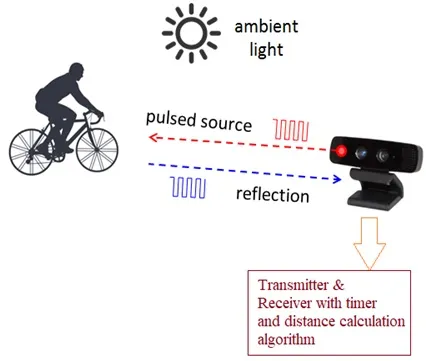
A Time of Flight camera illuminates a scene using a modulated light source and observes the reflected light. By measuring the phase shift between the emitted and reflected signals, the distance to objects in the scene can be calculated.
The depth can be calculated using the following equation:
Depth, d = c * ΔT / 2
Where:
- c = Speed of light (3 x 10⁸ m/s)
- ΔT = Time interval between light emission and light received by the camera sensor
ToF systems typically use a solid-state laser or LED in the near-infrared range for illumination. The reflected light is detected by an imaging sensor, which converts the photon energy into electric current. The light source can be either continuous or pulsed, leading to two primary ToF techniques: direct ToF (DToF) and indirect ToF (IToF).
There are generally considered to be three major 3D vision technologies: Time of Flight (ToF), stereo vision, and structured light.
Benefits or Advantages of Time of Flight Cameras
- Compact and Easy to Use: ToF cameras are generally small and straightforward to integrate into various systems.
- High Accuracy and Frame Rates: They offer precise depth measurements and can capture data quickly.
- Fast Response Time: Compared to stereo vision and structured light technologies, ToF cameras react more quickly to changes in the scene.
- Good Performance in Varying Lighting: ToF cameras function well in both low-light and bright-light conditions.
- Less Sensitive to Mechanical Alignment: The technology is relatively robust against slight misalignments.
- High Field of View and Resolution: 3D ToF cameras often provide a wide field of view, high sensor resolution, and effective object classification capabilities.
Drawbacks or Disadvantages of ToF Sensors
- Lower Resolution (Currently): Compared to structured light techniques, current ToF technology generally offers lower resolution, though this is rapidly improving.
- Susceptibility to Ambient Light: Strong ambient light (e.g., sunlight), multipath reflections, and scattered light can degrade performance. This requires careful consideration in the camera’s algorithm design.
- Calibration Complexity: Building a ToF camera is a complex process due to the calibration requirements.
Summary
Time of Flight cameras have become valuable components in smartphones, robotics, industrial automation, automotive systems, and augmented reality by providing accurate real time depth information. Their depth sensing advantages enhance object recognition, gesture control, and spatial mapping, although ambient lighting, reflective materials, and measurement range should be considered when evaluating system performance.