
What is TDMA and FDMA: Comparison, Advantages and Disadvantages
Advertisement
Time Division Multiple Access (TDMA) and Frequency Division Multiple Access (FDMA) are multiple access techniques that allow multiple users to share communication channels efficiently. Their advantages include improved spectrum utilization and organized resource allocation, whereas their disadvantages include synchronization complexity, guard band requirements, and reduced flexibility under varying traffic conditions.
Introduction: To understand the concepts of TDMA and FDMA, consider the example of a GSM system. In this system, a mobile user (user-1) utilizes the resources of a base station (frequency and time) to communicate with another mobile user (user-2). Transmissions from the mobile user to the base station are known as the uplink, and transmissions from the base station to the mobile user are known as the downlink.
What is FDMA?
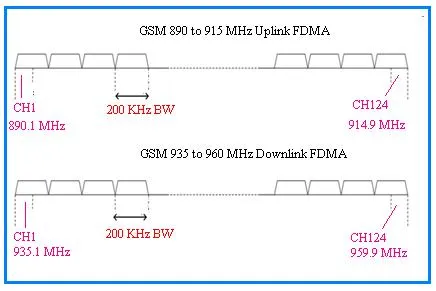
In GSM, a large frequency band (25 MHz) is divided into smaller frequency bands (200 KHz) known as channels. Moreover, separate frequency bands are allocated for the uplink (890 to 915 MHz) and downlink (935 to 960 MHz), as shown in the figure above. A total of 124 channels are available, each having 200KHz bandwidth in each direction (uplink and downlink).
For communication between users and the Base station, one dedicated frequency is used for the uplink and one for the downlink. Hence, simultaneous transmissions are possible in GSM. This process is known as FDMA (Frequency Division Multiple Access).
Example: FDMA is used to share satellite bandwidth among multiple ground stations (e.g., VSATs).
Benefits or Advantages of FDMA
- It allocates dedicated frequencies to different stations. Moreover, there are separate bands for both uplink and downlink. Hence, stations transmit and receive continuously at their allocated frequencies.
- It is very simple to implement with respect to hardware resources.
- FDMA is efficient when constant traffic needs to be managed with a smaller number of users.
Drawbacks or Disadvantages of FDMA
- In FDMA, frequencies are allocated permanently, and hence the spectrum will be wasted when stations are not transmitting or receiving.
- Network and spectrum planning can be cumbersome and time-consuming.
- It uses guard bands to prevent interference. This wastes very useful and scarce frequency resources.
- It requires RF filters to meet stringent adjacent channel rejection specifications. This increases the cost of the system.
- The maximum bit rate per channel is constant and hence cannot be used for varying data rate requirements as per QoS and priorities.
What is TDMA?
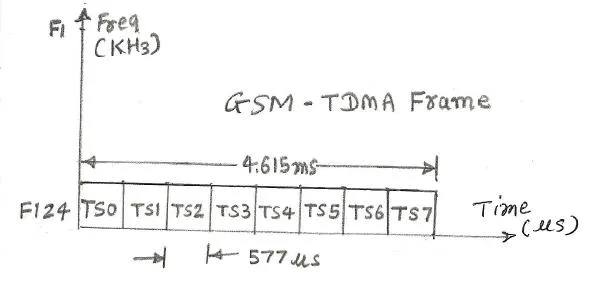
Frequency is a critical resource. In order to support more users with a single base station, eight time slots are allocated to each channel in GSM, as shown in the figure above. Hence, eight users can communicate with a single frequency channel. This process is known as TDMA (Time Division Multiple Access).
GSM systems utilize both TDMA and FDMA to use available time and frequency resources efficiently.
Benefits or Advantages of TDMA
- Stations transmit on a single frequency (say ‘f1’) but at different time instants. Likewise, they receive on another frequency (say ‘f2’) at different time slots. As TDMA makes efficient use of the spectrum, more users can use the same spectrum than an FDMA system.
- The operational costs of TDMA networks are lower compared to traditional FDMA networks.
- Different types of traffic (e.g., voice, data, and video) are transmitted using TDMA techniques, as this requires different data rates which can be easily achieved using the allocation of multiple time slots.
- Resources are utilized effectively on a need basis, and hence battery life can be enhanced.
- It can be used along with DAMA (Demand Assigned Multiple Access) to utilize frequency/time resources efficiently on a need basis.
Drawbacks or Disadvantages of TDMA
- Network and spectrum planning require more effort.
- Multipath interference affects call quality.
- Switching from one base station cell to another can result in dropped calls.
Summary
TDMA and FDMA have played significant roles in cellular, satellite, and wireless communication systems by enabling multiple users to access shared communication resources efficiently. Their multiple access advantages support reliable communication, although bandwidth efficiency, scalability, and synchronization requirements influence their suitability for modern wireless networks.