
What is Reed Switch: 5 Advantages and Disadvantages
By RF Wireless Expert Team
Advertisement
A reed switch is an electrically operated magnetic switch that opens or closes its contacts in response to an external magnetic field. Its advantages include simple operation, fast switching, and low power consumption, while its disadvantages include limited switching capacity and susceptibility to mechanical damage from excessive vibration.
Construction of Reed Switch
- A reed switch is a magnetically activated mechanical switch.
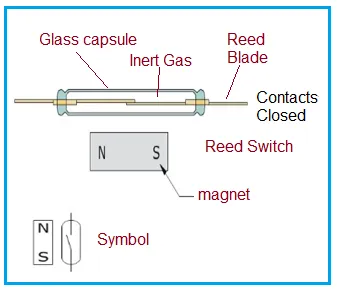
- It consists of two metallic contacts enclosed in a small enclosure, typically a glass capsule.
- The contacts are magnetic and move in response to a magnetic field. A permanent magnet is needed to activate the switch.
- There are two main types of reed switches: SPST (Single Pole Single Throw) and SPDT (Single Pole Double Throw). The most common type is SPST, which can be either normally open or normally closed.
- A common everyday application of reed switches is in alarm systems. In this application, the reed switch and a magnet are mounted very close to each other on a door or window. Normally, the switch is closed. When the door or window opens, the switch opens, breaking the circuit and triggering the alarm.
- The figure above depicts the construction of a reed switch and its symbol.
- The physical size of the reed switch depends on its current switching capability.
Benefits or Advantages of Reed Switches
- Simple Operation: Additional components are not needed for operation, except for a magnet.
- AC/DC Compatibility: It can switch both AC and DC.
- Voltage Switching Capability: It can switch voltages up to 200V in certain cases. Some variants can switch up to 500mA.
- Zero Power Consumption: It can be used by a magnet in an open or closed state indefinitely without any power consumption.
- Environmental Resistance: Its performance is not affected by dust or dirt, unlike optical switches.
- Activation Through Materials: It can be activated through non-magnetic materials such as plastic or paper.
Drawbacks or Disadvantages of Reed Switches
- External Magnet Required: It requires a separate magnet for operation. Furthermore, it does not work satisfactorily when the magnet is more than a few millimeters away from the switch.
- Size Limitations: Reed switches cannot be miniaturized to the same extent as other surface mount chips.
- Fragility: The glass envelope can be easily damaged.
- Arcing: Arcing may occur between the contacts.
- Limited Sensing Material: Only ferrous objects can be used for sensing an object that comes between the switch and the magnet.
- Susceptibility to Magnetic Fields: It can be accidentally activated by other magnetic fields.
- Debouncing Required: It must be debounced when connected to a controller or logic chip.
Summary
Reed switches provide reliable magnetic sensing and switching for industrial automation, automotive systems, consumer electronics, and security devices. Their simplicity and durability offer numerous practical benefits, although electrical and mechanical limitations should be considered during circuit design.