
What is Myoelectric Prosthesis Arm : Working, Advantages Disadvantages
Advertisement
A myoelectric prosthesis arm is an advanced artificial limb controlled using electrical signals generated by residual muscles in the user’s body. It offers natural movement, improved functionality, and enhanced independence for amputees. Challenges include high cost, maintenance requirements, training needs, and dependence on battery powered electronic systems.
Introduction: The term “Myoelectric” is a combination of two words: “Myo,” meaning muscle, and “electric,” referring to electricity. Together, it signifies the electric properties of muscles.
A myoelectric arm is an electrically controlled prosthetic device. Like other prosthetic devices, it provides the user with the ability to control the limb using impulses generated by their existing muscles. In the medical field, “prosthesis” refers to any artificial device that replaces a missing body part, such as an arm or leg.
Myoelectric Prosthesis Arm Working Principle
Artificial arms or limbs are categorized into two types:
- Passive: These arms lack any grasping function. They are designed for cosmetic appearance and aim to provide a realistic look.
- Functional: These arms are either body-powered or electrically powered. Cable-operated hooks or hands fall under the category of body-powered prosthesis devices. They are operated by a cable or harness system, where pulling the cable using back and shoulder muscles opens or closes the hand.
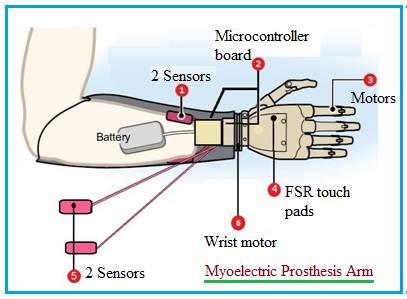
The image above illustrates the components of a myoelectric prosthesis arm. A battery provides power to the circuits within the device. Let’s break down the working principle of this battery-operated arm:
- Muscle Impulse Generation: Muscle contractions in the residual arm generate muscle impulses.
- Electrode Sensors: Electrode sensors embedded on the surface between the residual arm and the prosthetic device pick up these impulses.
- Signal Conversion: The impulses are converted into electrical signals.
- Electronic Circuitry: The electrical signals are sent to an electronic circuit, which generates current.
- Amplification and Filtering: The current is amplified and filtered to strengthen the input signals.
- Servo Motor Activation: The amplified current drives a servo motor, which actuates the arm to either open or close, as per the user’s intention. Separate motors can also be used for wrist movement and individual finger control.
By programming and utilizing respective sensors and microcontroller logic, one can drive selective motors as needed. Force Sensitive Resistors (FSRs) based touch pads can be used to activate individual fingers.
Benefits or Advantages of Myoelectric Prosthesis Arm or Limb
- Improved Quality of Life: Myoelectric prosthesis devices can significantly improve the quality of life for individuals with disabilities, providing them with a sense of normalcy and independence.
- Functional Movements: They enable movements such as elbow flexion/extension, finger opening/closing, and wrist supination/pronation.
- Enhanced Grasping Ability: They offer a secure hold, quick reflexes, and the ability to grasp objects effectively.
- Flexibility and Variety: They are flexible in their functionality and are available in various sizes to suit individual needs.
- Ease of Use: They are generally easy to learn and use.
Limitations or Drawbacks or Disadvantages of Myoelectric Prosthesis Arm or Limb
- Motor Replacement: The motor needs to be replaced periodically based on its lifespan.
- Cost: They are relatively expensive, making them inaccessible to everyone.
- Skin Irritation: The materials used can sometimes cause skin irritations, inflammations, or infections.
- Limited Lifespan: Frequent use can lead to the need for complete arm replacement within a few years (approximately 3-5 years).
- Socket Replacement for Children: Sockets require replacement as children grow.
Summary
Myoelectric prosthetic arms use muscle-generated electrical signals to provide intuitive control and improved mobility for amputees. Explore their working principle, advantages such as natural movement and functionality, and disadvantages including cost, maintenance, and training requirements.
Advertisement


