
What is Li-Fi Internet : 5 Advantages and Disadvantages, Working
Advertisement
LiFi (Light Fidelity) is a wireless communication technology that transmits data using visible light from LEDs instead of radio waves. It offers high speed data transfer and enhanced security in indoor environments. Advantages include large bandwidth and reduced RF interference, while disadvantages include line of sight requirements and limited coverage range.
LiFi based internet Architecture Working
LiFi uses LEDs for data transmission. Unlike WiFi, which relies on radio waves, LiFi uses visible light to transmit data within the optical spectrum, ranging from 380 nm to 780 nm. The technology is based on visible light communication (VLC) and is defined by the IEEE 802.15.7 standard. It utilizes modulation schemes like OOK, CCK, and VPPM to achieve different data rates. Promising faster speeds and increased bandwidth compared to traditional Wi-Fi, LiFi has garnered significant attention in recent years.
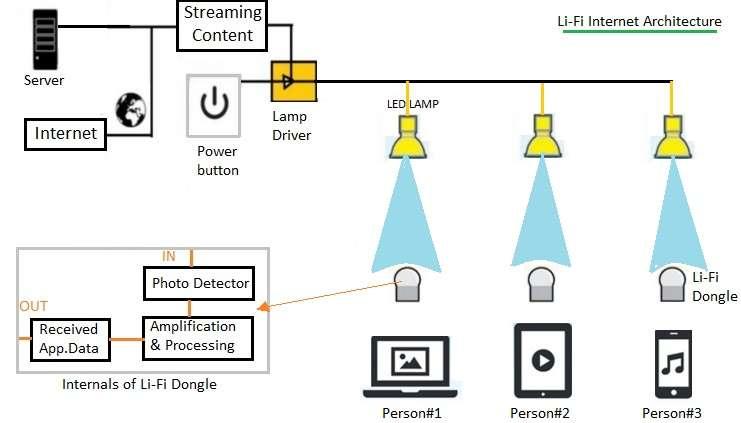
In a typical LiFi system, LED lamps serve as the data transmitters, while photo detectors in LiFi dongles receive the data. Applications include lighting, internet access, signboards, traffic signals, and more.
LiFi operates by modulating the intensity of LED light bulbs at extremely high speeds, which are imperceptible to the human eye. These fluctuations in light carry digital data, which is then received by a photodetector in a LiFi-enabled device and converted back into usable data.
Unlike WiFi, which relies on radio frequencies, LiFi can offer higher bandwidth, faster data transmission speeds, and reduced interference, making it ideal for environments where radio waves are restricted, such as hospitals, airplanes, or industrial settings.
Advantages of LiFi technology
- High Data Transfer Rates: LiFi enables fast data transmission, making it suitable for internet applications.
- Enhanced Security: As LiFi relies on line-of-sight communication, the signal is confined to a limited area and does not pass through walls, reducing the risk of unauthorized access.
- Energy Efficiency: LiFi devices consume low power, making them ideal for IoT applications and reducing energy usage in lighting systems. Moreover LiFi can coexist with existing lighting systems, making it an energy efficient solution as it combines illumination and data transmission in one system.
- Alleviates RF Spectrum Congestion: Since LiFi operates in the optical spectrum, it helps reduce congestion in the crowded RF spectrum.
- Health Benefits: Optical communication is safer than RF, as it poses no known health risks.
- Easy Installation: Setting up a LiFi system is straightforward and offers potential energy savings in lighting systems.
Disadvantages of LiFi technology
- Limited Range: LiFi works only within the range of the light source and cannot penetrate walls, limiting its range compared to WiFi.
- Outdoor Limitations: Sunlight and other optical sources can interfere with LiFi, making it less effective in outdoor environments.
- New Infrastructure Required: Adopting LiFi requires new infrastructure, which can increase the initial setup cost.
- Constant Light Requirement: LiFi requires lights to remain on for continuous internet access, which can lead to energy waste, especially at night.
- Limited Usability in Darkness: LiFi systems cannot function in the dark, making it inconvenient for certain situations, like using the internet before sleep.
Summary
LiFi uses light based communication for high-speed wireless networking. Advantages include fast data rates and improved security, while disadvantages include coverage limitations and dependence on lighting conditions.
Advertisement


