
What is VLAN: Advantages and Disadvantages
Advertisement
A VLAN (Virtual Local Area Network) is a logical network that divides a physical network into separate broadcast domains to improve performance and security. Its advantages include simplified network management and reduced broadcast traffic, while its disadvantages include configuration complexity and dependence on compatible networking equipment.
VLAN Network Architecture & Protocol Frame Structure
VLANs facilitate host-to-host communication, even when hosts are located far beyond the typical range of a Local Area Network (LAN). This is achieved because VLANs can span multiple switches situated in different buildings or office spaces. The IEEE 802.1Q standard defines VLANs, and they often utilize the VLAN Trunking Protocol (VTP) for traffic routing.
VLAN stands for Virtual Local Area Network. It’s a networking technique that logically divides a physical network into multiple, independent virtual networks. This enables network administrators to group devices based on their functions, even if they’re spread across a building.
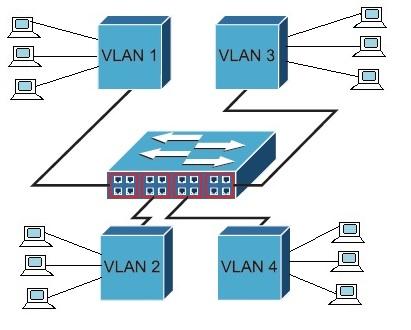 Figure: VLAN network operation
As illustrated above, numerous VLANs can coexist on a single Ethernet switch. Each VLAN will have a distinct set of ports assigned to it. The figure depicts an Ethernet switch configured for four separate VLANs.
 Figure: VLAN Ethernet Frame
The figure depicts an Ethernet frame with a VLAN tag. As shown, it is inserted between the source address and the Type/Length fields.
This tag, also known as the VLAN header, is 4 bytes (32 bits) in size and identifies the VLAN membership of the frame. It’s crucial for identifying and segregating traffic belonging to different VLANs within the network.
The VLAN tag contains the following fields:
- TPID (Tag Protocol Identifier): 2 bytes in size.
- VLAN ID or Tag ID: 12 bits, with a range from 0 to 4095. VLANs with the same VLAN ID are considered part of the same VLAN.
- PCP (Priority Code Point) or Priority Field: 3 bits, used for Quality of Service (QoS) differentiation.
- CFI (Canonical Format Indicator) or Drop Eligible Indicator: 1 bit, typically set to zero (0).
Benefits or Advantages of VLAN
-
Enhanced Security: VLANs provide network segmentation, isolating traffic and creating distinct security zones. This enhances security by reducing the risk of unauthorized access or attacks targeting sensitive systems or departments from other network segments.
-
Performance Improvement: By segmenting the network, VLANs reduce congestion and improve overall network performance.
-
Simplified Network Management: PCs or laptops within a VLAN can be managed as a single entity. This simplifies administration, control, and troubleshooting.
-
Flexibility and Scalability: New VLANs can be created or modified without physically reconfiguring the network. This allows for easier adaptation to changing business requirements and simplified network expansion.
-
Virtual Workgroups: VLANs enable the creation of virtual workgroups by grouping devices based on their functional requirements or team affiliation. This enhances collaboration and simplifies network access control, regardless of physical location.
-
Guest or Visitor Isolation: VLANs allow you to isolate guest networks from the internal network. This allows visitors to access resources while keeping sensitive data and systems separate.
-
Compliance and Regulatory Requirements: VLANs help organizations meet specific security and privacy standards by implementing data separation.
Drawbacks or Disadvantages of VLAN
-
Implementation Complexity: Implementing VLANs in a large organization can be complex, requiring careful planning, configuration, and coordination to ensure proper VLAN assignments.
-
VLAN Hopping Vulnerability: If VLANs are not properly secured, there’s a risk of VLAN hopping. This is where an attacker gains unauthorized access to traffic on a different VLAN, typically due to a misconfigured switch or inadequate security measures.
-
Overhead: VLAN tagging and processing can add overhead to networking devices like switches and routers, potentially leading to increased latency and reduced throughput.
-
Interoperability Challenges: Differences in VLAN implementations between different vendors can lead to interoperability issues.
-
Additional Costs: Implementing VLANs may require additional costs for VLAN-capable switches, routers, and networking tools (if required).
Summary
VLAN technology enhances network security, efficiency, and scalability by enabling flexible logical segmentation without requiring additional physical infrastructure.
Advertisement


