
What is Magnetron : Advantages and Disadvantages
Advertisement
A magnetron is a high power microwave vacuum tube that generates RF energy using the interaction of electrons with magnetic and electric fields. It is widely used in microwave ovens, radar systems, and industrial heating equipment. Advantages include high efficiency and power output, while disadvantages include frequency instability and limited modulation capability.
Magnetron Constuction, Working and Applications
A magnetron is a type of self excited, high power microwave oscillator that utilizes multiple cavities. It differs from linear beam tubes like klystrons and traveling wave tubes (TWTs).
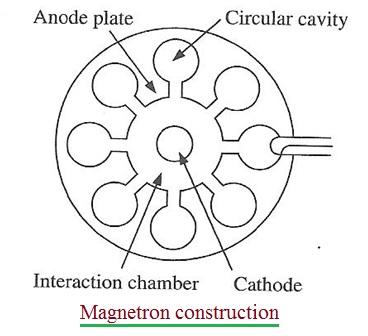
Image Alt: Magnetron
Magnetrons find use in a variety of applications, including:
- CW oscillators in pulsed radar systems
- Voltage-tunable magnetrons as sweep oscillators
- Fixed-frequency oscillators in microwave ovens and heating appliances
A magnetron is essentially a simple diode vacuum tube featuring multiple cavity resonators and a powerful C-shaped permanent magnet. The magnet consists of a cylindrical anode block, typically containing 8 to 20 equally spaced resonant cavities. These cavities are designed to control the output frequency.
The diameter of each cavity is equal to (λ/2) of the desired operating frequency. Figure 1 (not included here) depicts a construction diagram of a magnetron tube.
The interaction chamber facilitates the interaction between the electric (E) and magnetic (H) fields, enabling force to be exerted on the electrons. The magnet provides the necessary magnetic field parallel to the axis of the cathode.
The output signal is extracted using a probe or loop coupled to either a waveguide or coaxial cable.
Benefits or Advantages of Magnetron
- High Power Output: Magnetrons are used as high-power output oscillators in both pulsed and CW (Continuous Wave) modes.
- Magnetron Sputtering: Magnetron sputtering is a high-rate vacuum coating technique employed for depositing metals, alloys, and compounds onto a wide range of materials. It boasts several advantages over other vacuum coating methods, including:
- High deposition rates
- Ease of sputtering
- High purity films
- High adhesion of films
- Ability to coat heat-sensitive substrates
Drawbacks or Disadvantages of Magnetron
- Mode Operation: Magnetrons are typically designed to operate in π-mode, where the phase difference between adjacent resonators is 180 degrees. For strong interaction between the wave on the anode and the electron beam, the phase velocity of the wave should be nearly equal to the drift velocity (VΦ). The oscillations for π-mode start at a specific beam voltage, V0h = (2πf)/N * (b2 - a2)*Bo, where V0h is known as the Hartree voltage, f is the operating frequency, and N is the number of resonators. These assumptions are crucial for successful magnetron operation and must be considered during the design phase to achieve the desired results.
- Tuning Limitations: While magnetrons can be tuned by varying the resonant frequency of the cavity (using ferrites and piezoelectric materials), this is typically practicable only at moderate power levels. Tuning magnetrons at high power levels can be difficult.
- Slow Wave Structure: Magnetrons do not have a slow-wave structure (i.e., the phase velocity is not significantly less than the speed of light), unlike TWTs and CFAs.
Summary
Magnetrons are efficient microwave power generators used in radar and heating applications. Advantages include high RF power and low cost, while disadvantages include limited frequency control and shorter operational flexibility.
Advertisement


