
What is LTN : Low Throughput Network Advantages and Disadvantages
By RF Wireless Expert Team
Advertisement
A Low Throughput Network (LTN) is designed for applications that require transmission of small amounts of data at infrequent intervals, such as sensors and monitoring systems. It prioritizes power efficiency over speed. Advantages include long battery life and low operating costs, while disadvantages include limited bandwidth and slower communication performance.
LTN network architecture & its elements
- LTN is a Wide Area Wireless Network technology with specific features compared to existing radio networks.
- It offers long-range (about 40 Km) communication at low throughput using minimal power.
- It’s ideal for M2M (Machine-to-Machine) traffic due to its low throughput (max. 50 kb/s) and lower latency (milliseconds to seconds). Typically, M2M devices send only a few bytes per day, week, or month.
- It’s also suitable for alarm, telemetry, control, sensing, and tracking applications.
- LTN networks can interoperate with cellular networks to address certain applications.
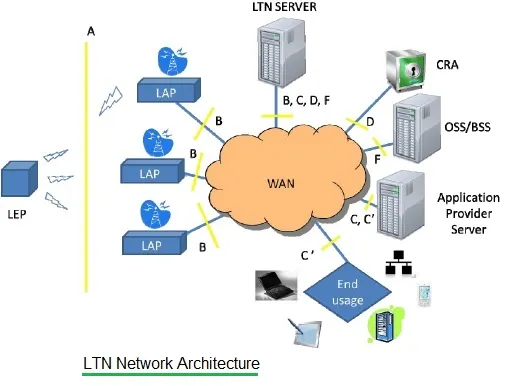
- LTN networks consist of LEPs (LTN End Points) and LAPs (LTN Access Points). These are supported and managed by Back End Systems. Moreover, they deliver end-user services via customer service platforms. Figure-1 (above) depicts LTN network architecture.
- It uses 868 to 915 MHz and 433 to 868/915 MHz (i.e., <1 GHz) frequency bands.
- A typical frame (i.e., payload) size used in LTN is about 12 bytes.
Benefits or Advantages of LTN (Low Throughput Network)
- It is a standalone network that provides open interfaces to create an ecosystem of end points, access points, networks, and service providers.
- LTN end points consume ultra-low power. Hence, a battery life of up to 20 years can be achieved with LTN devices.
- The network and its elements are optimized for low payload volume and low data rate applications.
- It offers a high budget link to provide improved coverage in urban and underground regions. It covers up to 10 to 12 Km (in the city) and 40 to 60 Km (across the countryside).
- It offers low costs of operations, maintenance, and ownership.
- It offers very low latency (from modem to availability of internet) usually in milliseconds to seconds.
- Transmitted data is encrypted to provide secure communications.
Drawbacks or Disadvantages of LTN (Low Throughput Network)
- It cannot be used for higher data rate applications carrying large amounts of payload volume.
- It is recommended to have a high sensitivity receiver with better than -135 dBm.
Summary
LTNs support low-data-rate applications with minimal energy consumption. Advantages include cost efficiency and extended device life, while disadvantages include low throughput and restricted functionality.