
What is NB-IoT: Advantages and Disadvantages
Advertisement
NB-IoT (Narrowband Internet of Things) is a low-power wide-area network technology developed for connecting IoT devices over cellular networks. It offers extended coverage, low energy consumption, and support for massive device deployments. Its limitations include lower data rates, higher latency, and reduced suitability for real time multimedia applications.
Key Features of NB-IoT System
NB-IoT, short for Narrowband-Internet of Things, is a technology specified in LTE Release-13. Also known as LTE cat-NB1, it was developed to meet the requirements of LPWA (Low Power Wide Area) networks.
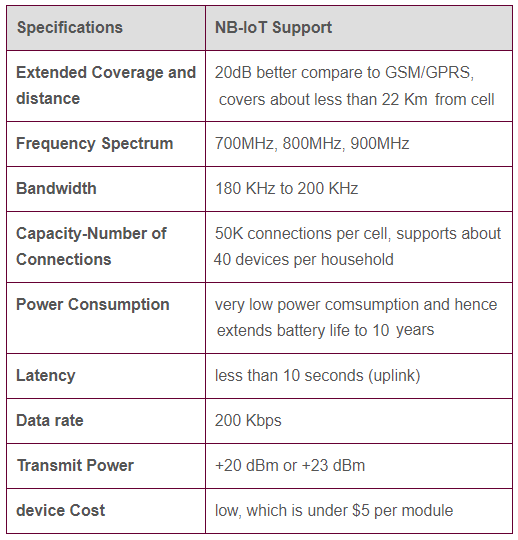
The following table outlines key features of an NB-IoT network.
NB-IoT has a wide array of applications for personal, public, and industrial use:
- Personal Applications: Wearables, tracking devices for kids/elders, smart bicycles, etc.
- Public Applications: Event detectors, smart garbage bins, smart metering, etc.
- Industrial Applications: Asset tracking, smart agriculture, logistics tracking, etc.
Low power consumption and long range are critical requirements for IoT, which are major challenges with mainstream cellular technologies. NB-IoT addresses these concerns. Low power wide area network protocols are designed to establish connections between low energy devices and a network server. It uses various deployment modes viz. standalone, LTE Guardband and LTE In-band.
Benefits or Advantages of NB-IoT
- Scalability, QoS, and Security: NB-IoT leverages mobile wireless networks, offering better scalability, quality of service, and security compared to unlicensed LPWA networks like LoRa/Sigfox.
- Long Battery Life: Due to its low power consumption, NB-IoT devices can achieve extended battery life.
- Extended Coverage: NB-IoT provides greater coverage compared to GSM/GPRS systems.
- Operator Support: Numerous network operators across Europe and Asia support NB-IoT.
- Long Range, Low Bit Rate Transmission: It’s designed for transmitting data at low bit rates over long distances, surpassing the range of GSM and LTE.
- Moderate Module Costs: NB-IoT modules are expected to be reasonably priced.
- Improved Penetration and Data Rates: Compared to unlicensed band-based standards (e.g., LoRaWAN and Sigfox), NB-IoT offers better penetration of structures and improved data rates.
- Coexistence with Legacy Cellular Systems: NB-IoT can coexist with older cellular technologies like GSM/GPRS/LTE. NB-IoT compliant devices can be deployed and scheduled within existing LTE networks, sharing capacity and cell resources with other connected devices.
Drawbacks or Disadvantages of NB-IoT
- Lower Data Rate: Compared to LTE cat-M1, NB-IoT offers a lower data rate (approximately 250Kbps download and 20Kbps upload) with a bandwidth of about 200 KHz. This makes it ideal for stationary devices.
- No VoLTE Support: NB-IoT does not support VoLTE (Voice Over LTE) for voice transmission, meaning voice communication is not directly supported.
- Limited Roaming: Roaming support is not as robust as in LTE-M and Sigfox, although this is expected to improve soon.
Summary
NB-IoT enables reliable and energy-efficient connectivity for smart meters, sensors, tracking devices, and industrial IoT applications. Discover the advantages and disadvantages of NB-IoT, including long battery life, deep coverage, low bandwidth, and latency constraints.
Advertisement


