
What is LPWAN : Advantages and Disadvantages
Advertisement
LPWAN (Low Power Wide Area Network) is a wireless networking technology designed for IoT devices requiring long-range communication with minimal power consumption. It supports applications such as smart metering, asset tracking, and environmental monitoring. Advantages include long battery life and broad coverage, while disadvantages include low data rates and higher transmission latency.
LPWAN Architecture and its applications
LPWAN is a type of wireless network specifically designed for low-power Internet of Things (IoT) and Machine-to-Machine (M2M) applications. Essentially, an LPWAN is a low-power WAN system that provides long-range communication between connected devices or sensors while maximizing battery life.
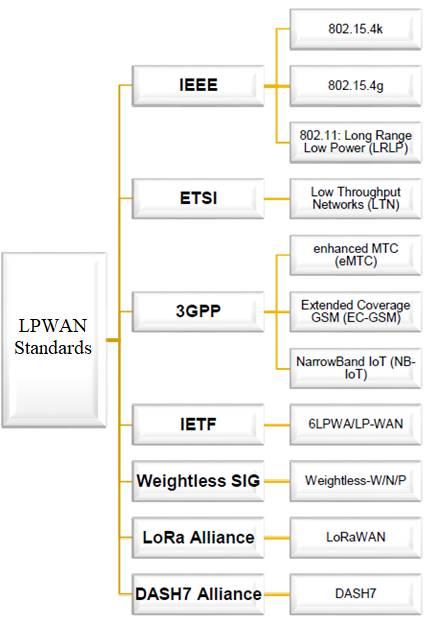
Here’s a visual representation of the LPWAN standards and their developing organizations:
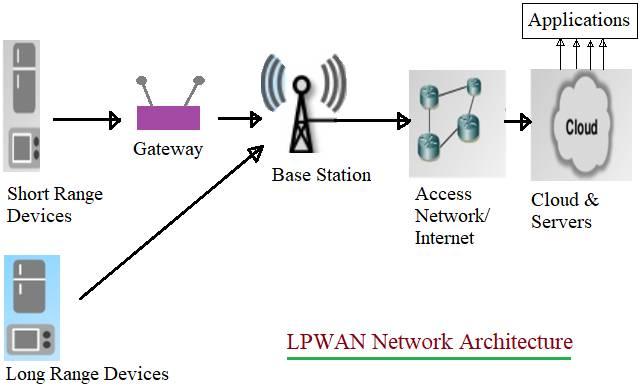
A typical LPWAN architecture consists of four main layers:
- End Devices (Sensors/Actuators)
- Gateways (Base Stations)
- Network Server
- Application Server / Cloud Platform
Data flows from IoT devices to gateways, then to network servers, and finally to applications where it is processed and visualized.
LPWANs are used in various applications, including:
- Smart Metering - Smart Parking - Smart Grid Control - Smart Security - Smart Cities - Smart Agriculture - Asset Tracking - Smart Home Automation - Critical Infrastructure Monitoring - Personal IoT Applications - Logistics
The following are some popular LPWAN technologies:
- NB-Fi - DASH7 - SIGFOX - LoRa - EC-GSM - NB-IoT - LTE-M - Weightless
Benefits or Advantages of LPWAN
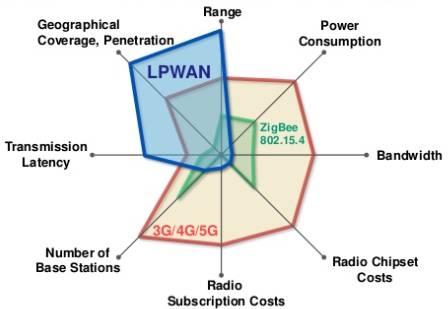
- Long Range: LPWANs offer a considerable communication range, typically from 5 Km to 30 Km.
- Low Power Consumption: Devices connected to an LPWAN consume very little power, resulting in extended battery life (approximately 10 years).
- Low Cost: The cost of LPWAN devices (sensors) and gateways is generally lower compared to other wireless technologies.
- Wide Coverage with Few Access Points: LPWANs require fewer access points (base stations or gateways) to cover large areas, like a city or even an entire country.
- Robustness in Complex Environments: The use of sub-GHz frequency bands makes LPWANs more resilient to interference and signal degradation in challenging environments.
- Excellent Penetration: LPWAN signals can penetrate walls and building basements effectively.
- Simple Installation and Management: The smart architecture of LPWANs makes network installation and management relatively easy.
- Secure Communication: LPWANs employ encryption algorithms to ensure secure data communication between nodes and gateways.
Drawbacks or Disadvantages of LPWAN
- Low Data Rate: LPWANs are designed for low data rate applications. They are not suitable for applications that require high-bandwidth communication.
- High Latency: LPWANs can experience high latency between end-to-end nodes, making them unsuitable for applications requiring real-time or near-real-time responses.
- Technology-Specific Limitations: Be sure to understand that each type of LPWAN technology (LoRa, NB-IoT, etc.) will also have its own limitations in addition to these general disadvantages.
Summary
LPWAN technologies provide energy efficient, long range connectivity for IoT applications. Advantages include extensive coverage and low power usage, while disadvantages include limited bandwidth and slower communication speeds. LPWAN technologies, including NB-Fi, LoRa, EC-GSM, NB-IoT, LTE-M, Sigfox, and Zigbee, offer a powerful solution for connecting low power devices over wide areas.
Advertisement


