
What is Insteon Technology : Advantages and Disadvantages
Advertisement
Insteon is a home automation technology that combines wireless RF communication and power line networking to control smart devices such as lighting, sensors, and appliances. It provides reliable device connectivity in smart homes. Advantages include dual mesh communication and easy integration, while disadvantages include proprietary architecture and ecosystem limitations.
Introduction : Insteon is a technology developed by a company based in Irvine, CA, USA. It allows home devices and appliances to communicate using RF (radio frequency), powerline communication, or both. It’s primarily used for smart lighting and electrical control applications, including home automation controlled via mobile devices, tablets, or computers. Typical Insteon devices include lamps, smart home appliances, remote control switches, Insteon hubs, sensors, thermostats, keypads, outlets, range extenders, and more. Modern devices like Google Assistant and Amazon Alexa are also compatible with Insteon technology.
Key Features of Insteon Network Technology
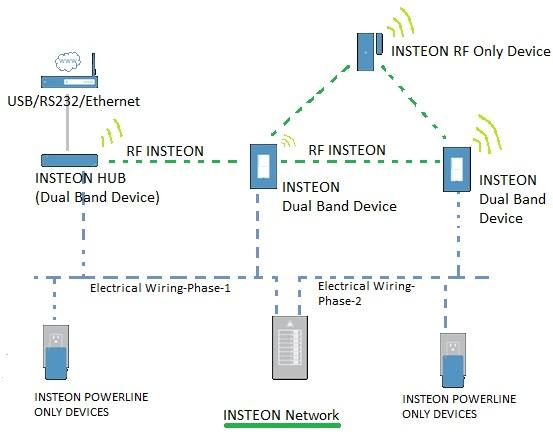
Figure: Typical Insteon Network
The image above shows a typical Insteon network. Insteon devices communicate directly without the need for routers. It uses a mesh topology, meaning each device can control other devices and can be controlled by others.
Insteon can address hundreds of devices due to its Simulcast feature, eliminating the need for complex routing. Insteon devices are usually managed in ad-hoc mode, without a hub. However, when an Insteon Hub or other controller is used, it provides better control of home devices via a smartphone app, both at home and remotely.
To control Insteon devices remotely using a mobile app, the Insteon hub needs to be powered on and connected to an internet router.
Here are some key features of Insteon technology:
- Operating Modes: RF, Powerline (PL), RF + Powerline
- Operating Frequencies: 915 MHz (US), 869.85 MHz (Europe), 921 MHz (Australia), 132 KHz (for PL)
- Network Configuration: Full mesh
- Addressing: Unique addressing mechanism with unique ID code and AES-256 encryption for messages
- Error Handling: Supports error detection and error correction
- Collision Avoidance: Supported
- Network Size: Approximately thousands of devices
- Modulation: RF mode uses FSK (Frequency-Shift Keying) for the physical layer (PHY), while Powerline PHY uses BPSK (Binary Phase-Shift Keying)
Benefits or Advantages of Insteon Technology
- Insteon devices communicate directly, peer-to-peer, without the need for routers or administrative master devices.
- It supports a larger network size (thousands of devices) compared to other wireless technologies such as Bluetooth, WiFi, Zigbee, and Z-Wave. This makes it suitable for larger homes and buildings.
- Insteon supports communication over powerlines, unlike other wireless technologies. Because it works on both RF and powerline, it offers more redundancy compared to single-band protocols.
- Message propagation uses the “Simulcast” feature, which helps in addressing more than a hundred nodes without complex and costly routing.
- Home automation devices can be controlled using a smartphone app while driving.
- Insteon technology is compatible with modern smart devices such as Nest, Amazon Echo/Alexa, Apple Watch, and Google Assistant.
- Tesla car owners can control Insteon devices from the touchscreen using an app called EVEConnect.
- It is backward compatible with X10 technology.
- Installation is simple because it uses existing wiring. Devices automatically join the network when powered on.
- Communication between devices is very quick, with message transmission taking a maximum of 0.05 seconds.
- Insteon uses AES-256 encryption, and Insteon devices use distinct IDs, providing greater security and resistance against eavesdropping and external control.
- Insteon is not as susceptible to interference as WiFi.
Drawbacks or Disadvantages of Insteon Technology
- It is not designed to support high data load applications such as HD video streaming.
Summary
Insteon technology enables smart home automation through combined RF and power line communication. Advantages include reliable connectivity, while disadvantages include limited interoperability and vendor dependency.
Advertisement


