
What is Emotion Sensing : Advantages and Disadvantages
Advertisement
Emotion sensing technology uses artificial intelligence, computer vision, voice analysis, and biometric sensors to identify human emotional states. It is used in healthcare, customer service, automotive systems, and market research. Advantages include personalized interactions and behavioral insights, while disadvantages include privacy concerns, ethical issues, and interpretation inaccuracies.
Introduction: Emotion sensing technology utilizes sensors and emotion recognition software to deeply understand human behavior and emotions with precision. It captures a person’s reactions, emotions, or feelings at any given moment. This technology goes beyond simple visual design creation, combining various elements into a comprehensive emotion sensing system. These include:
- Measurement of patterns
- Measurement of actions
- Facial expressions
- Voice intonation
- Body language
- Monitoring and analysis of behavior patterns
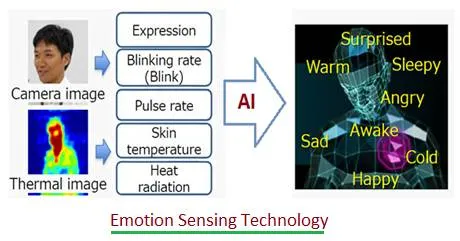
The emotion sensing technology is comprised of two main parts: emotion detection and emotion recognition.
- Emotion detection involves identifying human expression in the form of datasets based on circumstances, mood, or relationships with others.
It has applications in numerous fields, including:
- Educational and diagnostic software
- Robots
- Driverless cars
- Virtual reality
- Pervasive computing
- Video games
- Consumer electronics
Emotion sensing technology, coupled with Artificial Intelligence (AI), can read and analyze parameters like:
- Skin conductance
- Heart rate
- Eye movements
- Facial expressions
- Changes in voice
Smart devices equipped with these technologies will use emotional reactions to quickly convert them into data for analysis, allowing them to recommend appropriate actions. Currently, emotion sensing technology is used in healthcare and the automotive industry. Future applications are expected in medicine, advertising, VR, robotics, gaming, and education.
Advantages of Emotion Sensing Technology
- Stress Management: Helps employees and HR teams manage stress levels, fostering a healthy work environment and boosting productivity. Recognizing positive and negative moods of employees and customers will help businesses to grow.
- Cost-Effective Implementation: It doesn’t require additional expensive hardware, as AI recognition software is capable of handling emotion sensing.
- Enhanced Customer Service: Real-time voice-based emotion analysis allows automated customer service agents to recognize callers’ emotional states and adapt accordingly.
- Deeper Consumer Connections: Facilitates deeper emotional connections between companies and consumers through virtual assistant devices. Emotion-sensing wearables can also monitor users’ mental and other health parameters.
- Improved Care for Vulnerable Groups: Helps children and elderly people by enabling timely medical care and assistance through alerts to caregivers or family members.
- Social Media Analysis: Analyzing sentiments in social media comments can be helpful for countries and globally.
Disadvantages of Emotion Sensing Technology
- Dataset Validation: Validating emotion datasets is crucial for accurate emotion recognition systems.
- Emotion Detection Complexity: Finding or detecting emotions can be like searching for a needle in a haystack.
- Language Barriers: Making emotion sensing available in different languages presents a challenge.
- Software Limitations: There are limitations in different types and versions of softwares like dataset input being only textual data, and invalid image, pattern, video and audio inputs.
- Sensor Accuracy: The performance of emotion sensing systems depends on the accuracy of sensors like cameras, thermal image sensors, and facial recognition algorithms. Highly accurate systems can be expensive due to the use of costly components.
Summary
Emotion sensing enables machines to recognize and respond to human emotions. Advantages include enhanced user experiences, while disadvantages include privacy risks and accuracy limitations.
Continue Learning About Sensors & Types
- Sensor Vs. Transducer Vs. Actuator
- Active sensor Vs. Passive sensor
- Analog Vs. Digital Ssensors in IoT
- CCD Vs. CMOS Image Sensors
- Ultrasonic Vs. Infrared sensors
- Microwave sensor Vs. PIR sensor
- ECG sensor Vs. PPG sensor
- Check-out: Guide to List of Sensor Types >>