
What are Force Sensors : Load Cell vs. Piezoresistive
Advertisement
Force sensors measure mechanical force, pressure, or weight in industrial, automotive, healthcare, and robotics applications. Load cells use strain gauges for high-accuracy force measurement, while piezoresistive sensors detect resistance changes caused by applied force. Load cells offer superior accuracy and stability, whereas piezoresistive sensors provide compact size and faster response.
Introduction : According to Newton’s law, applying force to an object results in acceleration in the direction of the force. This relationship is expressed as F = m*a, where F is force, m is mass, and a is acceleration. Force is a vector quantity measured in Newtons. Force sensors are broadly categorized as quantitative (measuring force and converting it to an electrical signal) and qualitative. Examples of quantitative sensors include strain gauges and load cells.
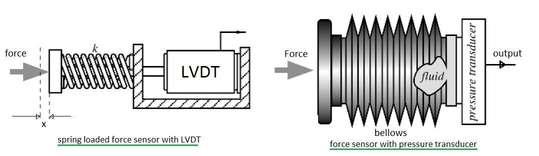
Advantages and Disadvantages Force Sensors
The following table summarizes the advantages and disadvantages of load cells and piezoresistive force sensors.
| Force Sensor Type | Advantages | Disadvantages |
|---|---|---|
| Load Cell | - Easily available. - High accuracy (typically <0.1% of full scale). - Usually pre-calibrated. | - Bulky size. - Rigid construction. - Requires expensive electronics. |
| Piezoresistive | - Very thin and flexible. - Uses inexpensive electronics. - Readily available and customizable. - Lightweight. - Low power consumption. | - Lower accuracy (around +/-5% full scale) compared to load cells. - Requires user calibration. |
Summary
Force sensors convert mechanical force into electrical signals for measurement and control. Load cells excel in precision and stability, while piezoresistive sensors offer compact design and rapid response for dynamic applications.
Advertisement


