
UWB Pulse Shapes: Communications, Ranging & Sensing
Advertisement
Introduction : In Ultra-Wideband technology, the shape of the transmitted pulse determines much more than just spectral compliance; it defines the device’s function. The transition from IEEE 802.15.4a to 4z, and now to 4ab, has introduced specific pulse shapes optimized for different tasks. From the legacy Root Raised Cosine to the ranging focused Butterworth, and finally the new Kaiser Window for sensing, this guide explores the physics and application of each UWB pulse shape and why the new standard mandates “zero sidelobes” for radar applications.
Communication Pulse (IEEE 802.15.4a)
- Shape Profile : Root Raised Cosine (RRC)
- Characteristics:
- Roll off factor (Beta) < = 0.45
- This pulse has visible sidelobes (ripples of energy on either side of main peak)
- Usage: General Data Transfer, used for standard payload data transmission to carry information
Ranging Pulse (IEEE 802.15.4z)
- Shape Profile : Eighth order butterworth
- Characteristics:
- Designed with minimum precursor energy
- The pulse rises sharply without significant energy arriving “early” (before the main peak).
- Usage: Accurate Time of Flight (ToF) Ranging
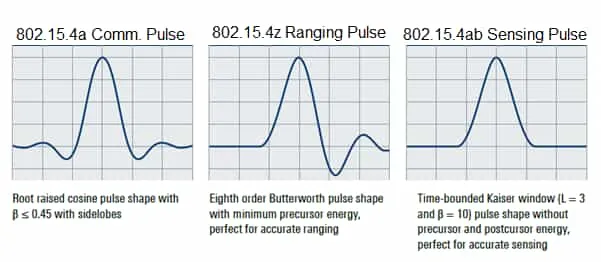 Image Courtesy : Rohde & Schwarz
Sensing Pulse (IEEE 802.15.4ab)
- Shape Profile : Time bounded Kaiser Window
- Characteristics:
- Parameters : Length, L = 3, Beta = 10
- Near zero sidelobes : The pulse is extremely clean. It lacks ripples seen in communication pulse
- No precursor/postcursor energy : It is strictly contained within its time boundary.
- Usage: Radar and Sensing (HRP-SDEV), The Kaiser window pulse ensures a clean Channel Impulse Response (CIR), allowing the device to distinguish small targets close to large static objects. It is used in radar, vital sign monitoring and gesture detection.
Summary: The evolution of UWB pulse shapes reflects the technology’s maturation from a data pipe to a precision sensing tool. Understanding these pulse profiles is vital for RF engineers aiming to pass conformance testing and achieve superior sensing performance.
Continue Learning UWB Technology
- UWB Basics Tutorial
- UWB Physical & MAC Layers
- UWB Frame Structure
- Understanding UWB Networks
- UWB Radar Tutorial
- UWB : Key Advantages & Disadvantages
- UWB Anchor Vs Tag : Key differences