
What are CCD and CMOS Image Sensors : Advantages and Disadvantages
Advertisement
CCD and CMOS image sensors are the core technologies used in digital cameras, smartphones, and machine vision systems to convert light into electronic signals. CCD sensors provide superior image quality, while CMOS sensors offer lower power consumption and faster operation. Each technology presents unique advantages and disadvantages depending on application requirements.
Introduction: An image sensor is essentially a two dimensional array comprised of thousands of individual pixels. When light strikes these pixels, it generates free electrons. The quantity of these electrons is directly proportional to the intensity of the incident light (photons).
Comparison and Working of CCD and CMOS Image Sensors
Both CCD (Charge-Coupled Device) and CMOS (Complementary Metal Oxide Semiconductor) sensors rely on the photoelectric effect to transform light photons into an electrical signal. The key difference lies in how they capture the digital image, convert the charge into voltage, and perform the readout of the chip.
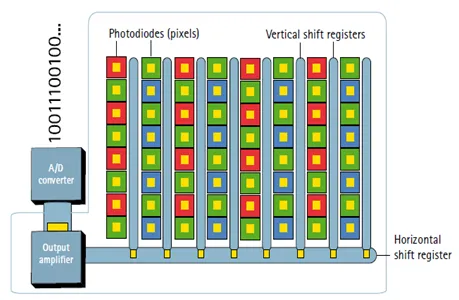 Figure 1: CCD image sensor
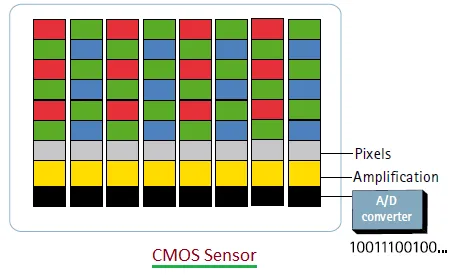 Figure 2: CMOS image sensor
Unlike CCD sensors, each pixel in a CMOS sensor has its own dedicated charge to voltage converter, amplifier, and pixel select switch.
Advantages of Image Sensors
Here are some key advantages of using image sensors:
- High Sensitivity (CCD): CCD image sensors excel in low-light conditions, offering high sensitivity for capturing images even when light is scarce.
- High-Speed Imaging (CCD): CCD sensors boast impressive high-speed imaging capabilities, leading to better daytime image performance.
- Reduced Damage Risk (CCD): CCD sensors are less susceptible to damage when exposed to bright light conditions.
- Data Discrimination: Image sensors can differentiate data transmitted from different sources, such as LED transmitters on vehicle rear lights and traffic lights, allowing for simultaneous capture and distinction.
- Noise Reduction: Background noise sources like sunlight, ambient light, and digital signage can be effectively filtered out by isolating the pixels associated with these noise sources. This leads to secure, interference-free, and reliable communication, particularly in outdoor environments.
Disadvantages of Image Sensors
Following are some of the drawbacks of image sensors.
- High Power Consumption (CCD): CCD image sensors tend to consume more power, often requiring active cooling to maintain optimal performance.
- Non-uniformity & Image Quality (CMOS): In CMOS sensors, the image quality can suffer from non-uniformity due to each pixel performing its own individual conversion.
- Limited Frame Rate: The frame rate of commonly used image sensors, typically around 30 frames per second, may not be sufficient for applications requiring high data rate communication.
- Line-of-Sight Limitation: Image sensors rely on detecting optical light, which is inherently line-of-sight. This means the performance of the link degrades when an object obstructs the light path, such as walls, buildings, thick gas, or dense fog.
- Shorter Battery Life (CCD): The higher power consumption of CCD image sensors can lead to shorter battery life in portable devices.
Summary
CCD and CMOS image sensors are widely used in digital imaging systems. CCD offers excellent image quality, while CMOS provides lower power consumption and faster processing capabilities.