
What is Capacitive Sensor : Advantages and Disadvantages
Advertisement
A capacitive sensor detects changes in capacitance caused by the presence, position, or movement of objects. It is widely used in touchscreens, proximity sensing, industrial automation, and level measurement. Advantages include high sensitivity and non-contact operation, while disadvantages include environmental sensitivity and susceptibility to electromagnetic interference.
About Capacitive Sensor
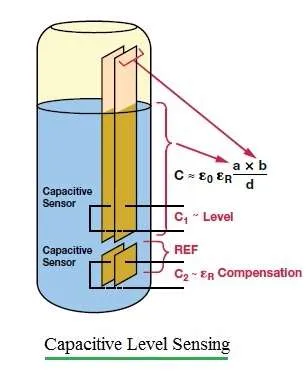
A capacitive sensor is a device that uses capacitive coupling to detect and measure objects. It can detect conductive materials or materials with a dielectric constant different from air. For example, in liquid level sensing, changes in the liquid between two sensors alter the dielectric material, causing a variation in capacitance.
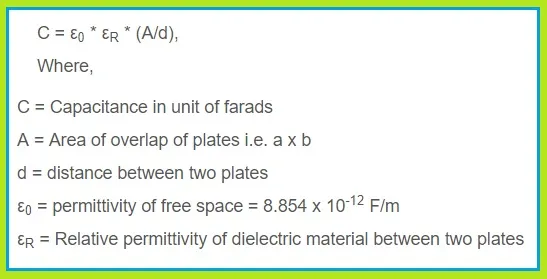
The capacitance of two parallel plates with Area (‘A’) and separated by distance (‘d’) is expressed as follows:
A major application of capacitive sensors is level sensing, as mentioned above.
Advantages of Capacitive Sensors
- It can be used to detect non-metallic targets.
- It can detect through containers of certain types.
- It is simple in construction and adjustable.
- It can detect dense targets and liquids.
- It is lower in cost.
- It has higher sensitivity and can be operational with small magnitudes of force.
- It can be used for the measurement of force, pressure, and humidity.
- It has very good resolution (as low as 0.003 mm) and frequency response.
Disadvantages of Capacitive Sensors
- It is very sensitive to changes in environmental conditions such as temperature and humidity. This will affect performance.
- The measurement of capacitance is harder compared to the measurement of resistance.
- Capacitive proximity sensors are not as accurate compared to inductive sensor types.
Summary
Capacitive sensors detect objects and motion through capacitance changes. Advantages include high sensitivity and durability, while disadvantages include interference and environmental effects.