
What is C-V2X in 5G : 5 Advantages and Disadvantages
Advertisement
C-V2X (Cellular Vehicle-to-Everything) is a 5G enabled communication technology that allows vehicles to exchange real time information with other vehicles, infrastructure, pedestrians, and networks. It improves road safety, traffic efficiency, and autonomous driving capabilities. Advantages include low latency and extended coverage, while disadvantages include deployment costs, infrastructure dependence, and interoperability challenges.
What is C-V2X?
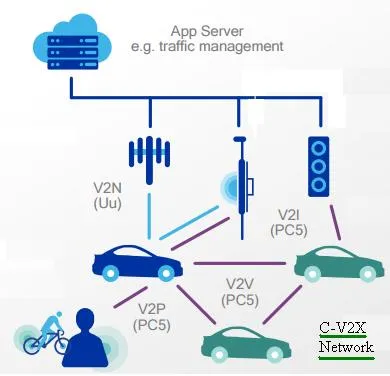
C-V2X, or Cellular Vehicle-to-Everything, is a network approach that unifies Vehicle-to-Vehicle (V2V), Vehicle-to-Pedestrian (V2P), Vehicle-to-Infrastructure (V2I), and Vehicle-to-Network (V2N) communications. It aims to support the requirements of autonomous vehicles and promote safer autonomous driving experiences.
- V2P: Vehicle to Pedestrian
- V2V: Vehicle to Vehicle
- V2N: Vehicle to Network
- V2I: Vehicle to Infrastructure
C-V2X has evolved through different standards, with increasing levels of safety features:
- 802.11p/C-V2X R14: Basic safety
- C-V2X R14: Enhanced safety
- C-V2X R15+: Advanced safety
The introduction of C-V2X direct communication into the 5G NR standard marks a significant step forward. C-V2X Rel-14/Rel-15 offers improved range and reliability for fundamental and enhanced safety applications, while C-V2X Rel-16 focuses on autonomous driving and advanced features for manually driven vehicles.
C-V2X supports two primary transmission modes:
- Direct Communication: Utilized for V2V, V2P, and V2I, following the PC5 interface within the ITS band (5.9 GHz).
- Network Communication: Used for V2N via the Uu interface.
Advantages of C-V2X
- Higher Spectral Efficiency: C-V2X can accommodate more users on the road thanks to its efficient use of radio spectrum.
- Enhanced Safety: Compared to alternative technologies, C-V2X provides a greater level of safety for drivers, passengers, and pedestrians.
- Superior Direct Communication: Facilitates better communication directly between vehicles without relying solely on network infrastructure.
- Improved Security: Offers a more secure communication environment compared to older technologies like 802.11p.
- Extended Range and Reliable Performance: Achieves longer communication ranges and more reliable performance for V2X safety applications at similar distances.
- 5G NR Benefits for Autonomous Vehicles: 5G NR C-V2X unlocks numerous benefits for autonomous driving, including higher throughput due to improved spectral efficiency, lower latency, greater reliability, and support for high vehicle speeds.
- Backward Compatibility: 5G NR C-V2X Rel-16 maintains backward compatibility with Rel-14 for safety features.
- Enhanced Situational Awareness: For safe autonomous driving, it provides 360-degree non-line-of-sight (NLOS) awareness and functions effectively at night and in adverse weather.
Disadvantages of C-V2X
- Vulnerability to Hacking: Because vehicles are connected to the internet, C-V2X systems are potentially vulnerable to hacking attempts.
- Privacy Risks: User privacy can be compromised as the system collects location data and other personal information.
- Autonomous System Failures: Failures in autonomous driving systems can lead to critical accidents. Rigorous testing is essential before deploying these systems for human use.
- Sensor Malfunctions: Malfunctioning sensors or car components can lead to inaccurate communications, potentially causing hazardous situations.
Summary
C-V2X is a 5G vehicle communication technology that enhances road safety and intelligent transportation. Key advantages include low latency and reliable connectivity, while disadvantages include infrastructure requirements and implementation complexity.