
What is Brain Computer Interface (BCI) : 5 Advantages and Disadvantages
Advertisement
A Brain Computer Interface (BCI) is a technology that enables direct communication between the human brain and external devices by interpreting neural signals. Applications include healthcare, assistive technologies, gaming, and robotics. Advantages include improved accessibility and control, while disadvantages include high costs, complexity, and ethical concerns.
Types of BCI
A BCI is a system that enables individuals with severe neuromuscular disabilities to communicate or perform everyday tasks using their brainwaves, typically measured via EEG. There are two main types as follows.
- One-way BCI: These systems either accept commands from the brain or send signals to it, but not both.
- Two-way BCI: These allow the brain and external devices to exchange information in both directions.
Based on the technology employed, BCI types in animals and humans can be categorized as:
- Invasive
- Semi-invasive
- Non-invasive
- Stimulating
- Bidirectional (or two-way)
Invasive BCI: Devices are surgically implanted directly into the brain. This provides the highest quality signals. These devices are often used to restore functionality to paralyzed individuals.
Non-invasive BCI: EEG signals are captured by placing electrodes on the scalp.
Semi-invasive BCI: ECoG (electrocorticography) signals are obtained from electrodes placed on the dura mater or arachnoid mater, beneath the skull.
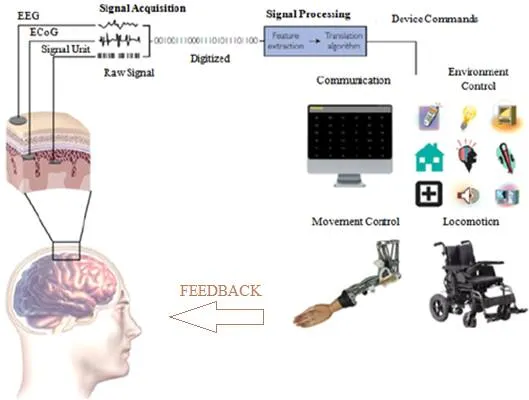
Image courtesy: www.researchgate.net
The electrical activity of the brain is displayed as brainwaves with varying frequencies (and amplitudes), reflecting different mental states.
Brainwaves are primarily categorized as follows:
- Infra-low wave: < 0.5 Hz
- Delta wave: 0.5 Hz to 4 Hz
- Theta wave: 4 Hz to 8 Hz
- Alpha wave: 8 Hz to 14 Hz
- Beta wave: 14 Hz to 30 Hz
- Gamma wave: 38 Hz to 42 Hz
Components of a Brain-Computer Interface (BCI)
The main components of a BCI system are:
- Signal Acquisition
- Preprocessing (Digitization)
- Feature Extraction
- Classification (using a translation algorithm)
- Signal Output (in the form of device commands)
BCI applications provide feedback to the user based on the signal output. Moreover, the signal output can be used to control external devices.
Some uses of BCI include:
- Providing disabled individuals with communication, environmental control, and movement restoration.
- Offering enhanced control of devices like wheelchairs, vehicles, or assistive robots for people with disabilities.
- Creating an additional control channel in computer games.
Advantages of Brain Computer Interface
Following are some of the potential benefits of BCI.
- Allowing paralyzed individuals to control prosthetic limbs with their minds.
- Transmitting visual images to the mind of a blind person, potentially restoring sight.
- Transmitting auditory data to the mind of a deaf person, potentially restoring hearing.
- Enabling gamers to control video games with their minds.
- Allowing a mute person to have their thoughts displayed and spoken by a computer.
Disadvantages of Brain Computer Interface
Following are some of the drawbacks of BCI.
- Electrodes placed outside the skull can only detect a limited number of electrical signals from the brain.
- Electrodes placed inside the skull can cause scar tissue to form in the brain.
- The current BCI technology is still relatively crude.
- BCI research is still in its early stages and has not yet reached a mature level.
- Ethical considerations may hinder its development.
Summary
Brain Computer Interfaces connect neural activity with digital systems for advanced human-machine interaction. Advantages include enhanced accessibility and control, while disadvantages include cost, complexity, and privacy concerns.