 RF
RFWhat is 5G RSMA : Advantages and Disadvantages
Advertisement
Rate Splitting Multiple Access (RSMA) is an advanced wireless access technique proposed for 5G and beyond networks. RSMA improves spectral efficiency, user fairness and interference management by splitting messages into common and private components, enabling better resource utilization and enhanced performance in multi-user communication environments. This page covers 5G RSMA (Resource Spread Multiple Access) basics, its different types, advantages (pros) and disadvantages (cons).
Introduction to 5G RSMA
5G technology employs various multiple access techniques. Among them are CP-OFDM/OFDMA for downlink, SC-FDM/SC-FDMA for uplink, and RSMA specifically for the Internet of Things (IoT). RSMA is particularly useful in scenarios that require asynchronous and grantless access.
RSMA Basics and Types
Here’s a breakdown of RSMA’s core functions:
- RSMA spreads the signal across allocated time and/or frequency resources.
- It uses lower rate channel coding, resulting in low spectral efficiency as a trade-off for robustness.
- Signals from different users can be recovered simultaneously, even with mutual interference present.
RSMA’s robustness stems from:
- The coding gain provides Eb/No efficiency compared to orthogonal spreading or simple repetition.
- It can utilize more powerful codes than simple repetition methods, often combined with low-rate convolutional codes.
The two primary types of RSMA are:
- Single Carrier RSMA
- Multi-carrier RSMA (or OFDM-based RSMA)
Let’s delve into the differences between single-carrier RSMA and multi-carrier (OFDM-based) RSMA.
Single Carrier RSMA
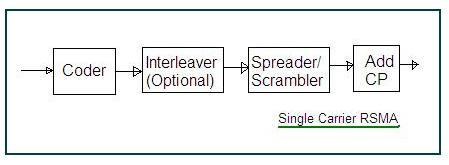
Figure 1: Single Carrier RSMA
Figure 1 illustrates single-carrier RSMA. The transmitter includes a coder, interleaver, spreader/scrambler, and a cyclic prefix (CP) addition module. On the receiver side, you’ll find CP removal, despreader, deinterleaver, and a decoder.
Single-carrier RSMA is known for its better power amplifier (PA) efficiency. Furthermore, it eliminates the need for strict synchronization.
Multi Carrier RSMA | OFDM based RSMA
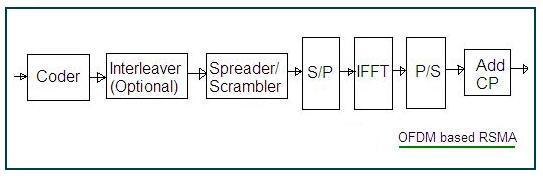
Figure 2: Multi Carrier RSMA, OFDM RSMA
Figure 2 depicts multi-carrier RSMA. The transmitter contains a coder, interleaver, spreader, serial-to-parallel (S/P) converter, IFFT, parallel-to-serial (P/S) converter, and a CP addition module.
The receiver includes CP removal, S/P, FFT, P/S, despreader, deinterleaver, and decoder modules.
Multi-carrier RSMA, leveraging OFDM, exploits wider bandwidths to achieve low latency. This makes it suitable for power-constrained applications such as M2M and IoT.
RSMA Advantages
-
Single Carrier RSMA Advantages:
- Allows asynchronous multiplexing
- Grantless transmission with minimal signaling overhead
- Link budget gain
-
OFDM based RSMA Advantages:
- Grantless transmission with minimal signaling overhead
RSMA Disadvantages
-
Single Carrier RSMA Disadvantages:
- Not suitable for higher spectral efficiency.
-
OFDM based RSMA Disadvantages:
- Requires synchronous multiplexing.
Advertisement


