
Coaxial Cable Cutoff Frequency Calculator | RF Design
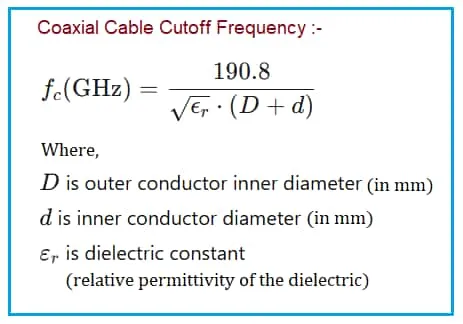
Find the upper frequency limit of coaxial cables before higher order modes occur. Calculate based on cable dimensions and dielectric constant.
Showing 25 posts (Page 1 of 2)
Advertisement
Find the upper frequency limit of coaxial cables before higher order modes occur. Calculate based on cable dimensions and dielectric constant.
Understand the difference between E-Mode and D-Mode GaN transistors. Learn how normally-off and normally-on architectures impact RF design and integration.
Explore the differences between FET mixers and image reject mixers, including their working principles, advantages, and limitations in RF systems.
Explore fractal antenna basics, including design principles, operational advantages, and application across multiple frequency bands.
Learn about IP2 and IP3, essential parameters defining nonlinear distortion in RF systems. Includes formulas, calculations, and importance.
Explore the variations of microstrip lines, including inverted, suspended, and shielded designs, along with their respective advantages and disadvantages.
Explore the design of millimeter wave up and down converters, essential for 5G, satellite, and radar systems. Learn about frequency shifting, linearity, noise, and bandwidth considerations.
Calculate the inductance of an NFC circular antenna using this online tool. Enter the number of turns, diameter, and spacing to find the inductance.
Compare oscilloscope based time domain load pull with traditional VNA systems for power amplifier design. Discover which method offers better PAE and ACPR.
Compare P1dB and TOI and explore difference between 1dB compression point (P1dB) and third-order intercept point (TOI) in RF design. Learn formulas and practical significance for system performance.
Explore the key differences between planar and conformal antennas, including technology maturity, beam control, polarization, gain, bandwidth, RCS, and installation aspects.
Explore Reflection coefficient calculator which calculates reflected voltage and reflection coefficient and learn Reflection coefficient formula.
Explore various resonator types including coaxial, dielectric, crystal, ceramic, SAW, and YIG. Understand their working principles, applications, and key vendors for optimal RF design.
Explore the pros and cons of RF amplifiers, covering gain, selectivity, power consumption, size, and design costs.
Explore RF frequency synthesizer design, block diagrams, components, and how they generate stable, precise RF signals for various communication systems.
Explore the key differences between RF linear and non-linear simulators, their applications, mathematical models, and when to use each for optimal RF system design.
Explore the differences between single, double, and triple balanced RF mixers. Learn their advantages, disadvantages, and applications in RF systems.
Explore the design of a 2-way Wilkinson RF power splitter at 800MHz. This design provides equal power division and good impedance matching.
Explore the functionality, design considerations, and applications of RF transceivers in wireless communication systems like Wi-Fi, LTE, and Bluetooth.
A curated list of RF, Wireless, and DSP job openings in WiMAX, WLAN, GSM, CDMA, and LTE technologies from various companies worldwide.
Explore the distinctions between scalar and vector mixers in RF design, their applications, and the challenges associated with vector mixer measurements.
Explore slotline basics, including antipodal and bilateral slotline types. Learn about advantages, disadvantages and applications of slotlines in RF design.
Explore the differences between stripline and microstrip transmission lines, including their structure, advantages, disadvantages, and applications in RF design.
Explore the design, components, and principles of C-band up and down frequency converters in satellite communication systems. Understand how they enable efficient signal transmission and reception.
Explore advantages and disadvantages of Doherty amplifier architecture, including power efficiency, complexity, and application suitability.
Advertisement