
Microwave Semiconductor Devices Explained
Advertisement
Microwave semiconductor devices are electronic components made from semiconductor materials that operate efficiently at microwave frequencies (approximately 1 GHz to 300 GHz). These devices are designed to generate, amplify, switch, detect, or control high-frequency electromagnetic signals. Compared with vacuum tube devices, microwave semiconductor devices are smaller, lighter, more reliable, and consume less power, making them indispensable in modern wireless communication, radar, satellite systems, medical equipment, and high speed electronics.
Common semiconductor materials used include Silicon (Si), Gallium Arsenide (GaAs), Gallium Nitride (GaN), Indium Phosphide (InP) and Silicon Carbide (SiC). Each material is selected according to the required operating frequency, power level, efficiency and thermal performance.
Classification of Microwave Semiconductor Devices
Microwave semiconductor devices can be broadly classified into:
- Microwave Diodes
- Microwave Transistors
- Microwave Integrated Circuits (MMICs)
- Optoelectronic Microwave Devices (used in specialized applications)
The first three categories are the most common in microwave engineering.
1. Microwave Diodes & their Types
Microwave diodes are two terminal semiconductor devices designed to operate efficiently at microwave frequencies. They are used for switching, detection, frequency generation, frequency multiplication and microwave power control.
1.1 Point Contact Diode
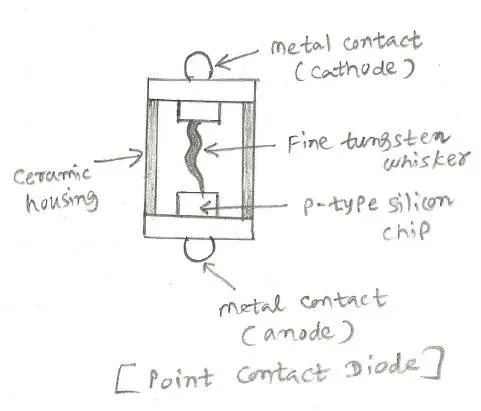
A semiconductor material with a piece of fine wire, as shown in the figure, is called a point contact diode. Here, capacitance is very low as the wire touches a small area of the material. Current flows from the cathode to the anode very easily but not in the opposite direction.
In the early days of technology, point contact diodes were manufactured using germanium. Nowadays, they are manufactured using P-type silicon with fine tungsten wire as the cathode. Point contact diodes are mainly used in mixers and detectors. They cannot withstand high power and are ideal for low signal applications.
1.2 Hot Carrier Diode/Schottky Diode
It is widely used as a microwave diode, also called a Schottky diode. They are made with N-type silicon semiconductor (as cathode) along with a thin deposited metal layer (as anode). Nickel chromium, aluminum, and gold are used as anode. They are used mainly in balanced modulators as well as in mixers and function as fast switches due to their high-frequency response.
1.3 Varactor Diode
The main application of this microwave semiconductor device, the varactor diode, is the frequency multiplier. The capacitance of this varactor diode device depends on the reverse bias applied to it. They are manufactured with gallium arsenide.
1.4 Step Recovery Diode
It is a PN Junction diode manufactured with gallium arsenide or silicon microwave semiconductor materials. They are used to develop multipliers with factors of 5 or 10. Step recovery diodes operate up to a frequency range of about 10GHz and a power rating of up to 50Watt. During forward bias operation, it stores charge; the same charge keeps the diode on momentarily when reverse bias is applied. Then, it gets off suddenly.
1.5 Gunn Diode
A Gunn diode is referred to as a Transferred Electron Device (TED). It is basically a piece of N-type GaAs or InP semiconductor which forms a resistance when voltage is applied to it. They oscillate at frequencies up to about 50GHz. Gunn diodes are used as Local Oscillators in receivers and also as a frequency source in transmitters. These devices exhibit negative resistance, just opposite to the standard Ohm’s law.
1.6 IMPATT/TRAPATT diode
These IMPATT/TRAPATT diodes are also used as oscillators. They are also PN junction diodes designed using silicon, GaAs, and InP. They operate at high reverse bias, which causes these devices to break down/avalanche. When these diodes are mounted in a cavity, they will produce oscillations. They are available up to 25Watt.
1.7 Tunnel diode
This microwave semiconductor device is used to produce low-power oscillators. When tunnel diodes are forward biased, they produce negative resistance.
1.8 PIN diode
A PIN diode consists of three semiconductor layers viz. P-type layer, Intrinsic (undoped) layer and N-type layer. The intrinsic layer increases carrier storage and allows the device to behave as a current controlled RF resistor.
2. Microwave Transistors & their types
Microwave transistors are three terminal semiconductor devices capable of amplifying or switching microwave frequency signals. Types are BJT, FET, MESFET and HEMT.
- BJT : A BJT consists of three semiconductor regions:viz. emitter, Base and Collector. They are arranged as either NPN or PNP structures. Can functions as rf amplifier, oscillator and signal switching device.
- FET : A FET consists of source, drain and gate. The gate voltage controls current flowing through the semiconductor channel. Can functions as low noise amplifier, rf amplifier, oscillator and mixer.
- MESFET : A MESFET uses a Schottky metal gate on a GaAs semiconductor channel. Can functions as microwave amplifiers, satellite communication, Radar receivers etc.
- HEMT : A HEMT uses a heterojunction formed between two semiconductor materials (commonly AlGaAs/GaAs or AlGaN/GaN), creating a high-mobility electron channel. Can functions as low noise amplifiers, satellite receivers, radio astronomy etc.
3. Microwave Monolithic Integrated Circuits (MMICs)
An MMIC integrates multiple microwave components such as amplifiers, mixers, oscillators, filters, and switches onto a single semiconductor substrate, typically GaAs, GaN, or InP. Available up to 8-10 GHz frequency range for various applications.
Construction of MMIC
An MMIC contains following:
- Active devices (transistors and diodes)
- Passive components (resistors, capacitors, inductors)
- Transmission lines
- Matching networks
All are fabricated using photolithographic semiconductor processes.
Summary
Microwave semiconductor devices form the foundation of modern high-frequency electronic systems. They include specialized diodes, transistors, and integrated circuits that perform essential functions such as amplification, oscillation, switching, tuning, and signal detection. Advances in semiconductor materials such as GaAs, GaN, and InP have enabled higher operating frequencies, improved efficiency, and greater reliability. These devices are now indispensable in telecommunications, radar, satellite communication, medical electronics, industrial systems, and emerging 5G/6G technologies.