
Microwave vs. Solid-State RF Heating Ovens : Key Differences
Advertisement
Microwave heating is a widely used technique for rapidly heating food and industrial materials using electromagnetic energy. Conventional microwave ovens typically use a magnetron to generate microwave energy, whereas modern solid-state RF heating ovens use semiconductor-based RF power amplifiers. Both systems convert electrical energy into electromagnetic waves that heat materials through dielectric heating, but they differ significantly in power generation, frequency control, heating uniformity, and efficiency.
What is Microwave Oven & its working
A conventional microwave oven operates on the principle of dielectric heating. Electromagnetic waves at a frequency of 2.45 GHz penetrate food and interact mainly with water molecules and other polar molecules. These molecules continuously attempt to align with the rapidly alternating electric field, producing molecular friction that generates heat throughout the food.
As mentioned, it uses a device called a magnetron that’s coupled with an antenna inside a closed cavity. A key limitation is that the excitation frequency within the cavity is fixed and cannot be altered.
What is solid state RF Heating Oven & its working
A solid state RF heating oven also uses dielectric heating but replaces the magnetron with solid state RF power amplifiers based on semiconductor devices such as LDMOS or GaN (Gallium Nitride) transistors. These amplifiers generate precisely controlled RF energy, allowing accurate adjustment of frequency, phase, and power.
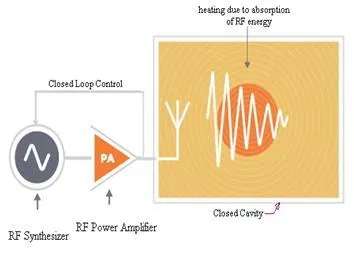
Figure-1: Solid State heating
Solid state cooking ovens replace the magnetron with a synthesized signal source and a Power Amplifier (PA). Figure 1 illustrates a solid state oven with its core systems. Notably, RF frequencies used in solid state ovens can start much lower than the microwave frequencies used in traditional microwave ovens.
A low power RF oscillator generates a stable microwave signal, typically near 2.45 GHz. Unlike a magnetron, the frequency can be adjusted slightly during operation.
Comparison Between Microwave Oven and Solid-State RF Heating Oven
| Feature | Conventional Microwave Oven | Solid State RF Heating Oven |
|---|---|---|
| Frequency range of operation | 300 MHz to 300 GHz | 3 KHz to 300 GHz |
| Excitation Source | Magnetron | RF synthesizer and RF Power Amplifier |
| Turn table requirement | Needed to heat food evenly | Not needed; heating is homogeneous from all sides |
| Heating effect | Non-homogeneous; cooks outer layers | Homogeneous; cooks food evenly throughout |
| Frequency/power variation | Not possible | Possible; frequency, power, and phase can be controlled to target specific areas within the cavity |
| Frequency sweep | Not possible; fixed RF frequency | Possible with synthesized source |
| Fine control of cooking | Not possible | Possible; allows for cooking different types of food simultaneously (e.g., vegetarian and non-vegetarian dishes) |
| Cost | Lower initial Cost | Higher initial cost |
| Control System | Basic electronic timer and controls | Digital signal processing with intelligent feedback |
| Maintenance | Magnetron replacement may be required | Lower maintenance requirements |
Conclusion
Solid state RF energy heating offers significant advantages over traditional microwave heating, positioning it as the future of quality cooking. Its versatility extends beyond cooking, with potential applications in areas like automotive ignition, drying, tumor ablation, and plasma lighting.