
What is SiC: 5 Advantages and Disadvantages
Advertisement
Silicon carbide (SiC) is a wide bandgap semiconductor material known for its exceptional thermal, electrical, and mechanical properties in power electronics. Its advantages include high efficiency, superior temperature tolerance, and faster switching speeds, whereas its disadvantages include higher manufacturing costs and more complex fabrication processes.
Key Characteristics of Silicon Carbide
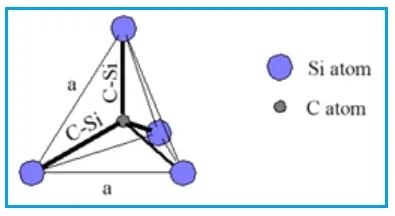
Silicon Carbide (SiC) is a semiconductor material composed of both Silicon and Carbon, with the chemical formula SiC. Its structure is shown in Figure 1. It possesses the following characteristics:
- Density: 3.1 g/cm3
- Linear expansion coefficient: 3.9 x 10⁻⁶ / °C
- Hardness: 2200 Kg/mm2
- Elastic Modulus: 380 GPa
- Poisson’s Ratio: 0.16
- Electrical Resistance: 108 Ohm-Cm
- It can be used at high temperature/voltage.
Benefits or Advantages of Silicon Carbide (SiC)
- High hardness
- Low thermal expansion
- High thermal consistency
- Good resistance at high temperatures
- Electrical conductivity
- Non-linear electrical resistance
SiC has many attractive benefits and is used for higher voltage, higher power, and high temperature applications. The following section highlights some of the challenges in manufacturing SiC devices.
Drawbacks or Disadvantages of Silicon Carbide (SiC)
- Silicon carbide is not available as a natural mineral. Hence, excessive furnace techniques are needed to produce the compound from Si.
- There is difficulty in doping in SiC fabrication due to its chemical inertness, physical strength, and low diffusion coefficient of other impurities.
- Different types of material defects are produced in SiC substrates with the present manufacturing processes.
- High manufacturing and processing costs due to difficulty in manufacturing large wafers of SiC with fewer defects and a lack of suitable processes.
- Contacts, interconnects, and passive components (e.g., inductors) should handle extreme conditions with reliability and durability in order to keep SiC functionally active in such conditions.
Summary
SiC technology is transforming power electronics by enabling compact, energy efficient, and high performance devices for electric vehicles, renewable energy, and industrial applications. Its material advantages significantly improve efficiency and reliability, although manufacturing complexity and production costs continue to influence market adoption.