
What is a Rat Race Coupler: Advantages and Disadvantages
Advertisement
A rat race coupler is a microwave passive component that equally splits or combines RF signals while providing phase differences between output ports. Its advantages include excellent port isolation and balanced signal distribution, whereas its disadvantages include narrow bandwidth and relatively large physical dimensions at lower frequencies.
Key features of Rat Race Coupler
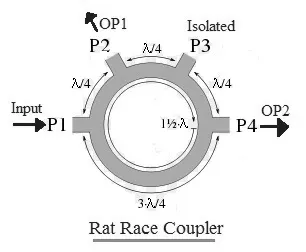
- A Rat Race Coupler is a hybrid coupler featuring four ports, as illustrated, with specific wavelength relationships between those ports.
- It can be implemented using microstrip, stripline, or waveguide technologies.
- Typical applications include balanced mixers and amplifiers, antenna feed networks, and power combiners/dividers.
Benefits or Advantages of Rat Race Coupler
- Acceptable Return Loss: Offers acceptable return loss at its ports.
- Good Isolation: Provides good isolation between its ports.
- Amplitude/Phase Balance: Exhibits excellent amplitude and phase balance across a wide frequency range, such as the D band (2.20 to 3.30 GHz).
- Magic Tee Functionality: Functions similarly to a magic tee, but without the need for a matching structure.
Drawbacks or Disadvantages of Rat Race Coupler
- Narrow Bandwidth: Has a relatively narrow bandwidth compared to some other coupler types.
- Large Area: Occupies a larger area due to the 3λ/4 length between ports P1 and P4 on the bottom section. This can be a limitation in space-constrained microwave devices.
- Construction-Specific Drawbacks: Its disadvantages are also tied to its construction method. Consider the drawbacks associated with microstrip lines, striplines, and waveguide structures.
Summary
Rat race couplers play a significant role in RF and microwave engineering by enabling efficient signal splitting, combining, and phase control. Their electrical performance makes them valuable in communication and radar systems, although bandwidth and size limitations influence practical implementation.