
What is RDBMS : 5-10 Advantages and Disadvantages
Advertisement
A Relational Database Management System (RDBMS) stores and manages structured data using tables, relationships, and SQL for efficient information retrieval. Its advantages include strong data integrity and reliable transaction management, while its disadvantages include scalability limitations for unstructured data and increased administrative complexity.
Key features of RDBMS & its System Components
- RDBMS stands for Relational Database Management System.
- It’s a relational model where data is organized into multiple tables. These tables are linked to each other using primary keys, foreign keys, and indexes.
- RDBMS employs database normalization techniques to minimize data redundancy within tables. This helps optimize storage and consistency.
- It facilitates efficient data retrieval using SQL queries.
- RDBMS is extensively used by enterprises and software developers for storing large volumes of complex data.
- Examples of RDBMS include SQL Server, Oracle, MySQL, MariaDB, and SQLite.
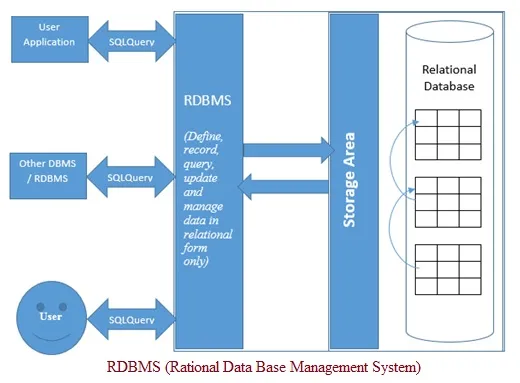
RDBMS is a specific type of DBMS, alongside other types such as Navigational, OODBMS, ORDBMS, Hierarchical DBMS, and Network DBMS.
The figure below illustrates common components found within an RDBMS.
Benefits or Advantages of RDBMS
- Easy to Use: RDBMS systems are generally designed to be relatively intuitive to interact with, especially with SQL as a standard language.
- Secure: They offer robust security features to protect data integrity and confidentiality.
- Data Manipulation: RDBMS allows for easy modification, insertion, and deletion of data.
- Reduced Redundancy: By employing normalization techniques, RDBMS minimizes duplicate data, leading to more efficient storage and reduced inconsistencies.
- Better Data Integrity: Constraints and relationships enforce data accuracy and consistency.
- Better Physical Data Independence: Changes to the physical storage of data do not necessarily affect the way applications access the data.
- Logical Database Independence: Different users can view the data in ways that are tailored to their specific needs without affecting the underlying data structure.
- Better Backup and Recovery Procedures: RDBMS systems typically have well-defined procedures for backing up data and recovering from failures.
- Multiple Interfaces: They support various interfaces for different types of users and applications.
- Multi-User Access: Multiple users can access and manipulate the database concurrently, a feature not always available in simpler DBMS systems.
Drawbacks or Disadvantages of RDBMS
- Expensive Software: RDBMS software can be costly, particularly for enterprise-level solutions.
- Expensive Hardware: Complex software often requires powerful and expensive hardware to run efficiently.
- Skilled Human Resources: Implementing and maintaining an RDBMS requires skilled database administrators and developers.
- Performance Limitations: Certain applications may experience slower processing speeds compared to other database models.
- Data Recovery Challenges: Recovering lost data can be complex and time-consuming in certain scenarios.
Summary
RDBMS technology remains the foundation of enterprise data management by providing consistency, security, and efficient querying for structured information. Its extensive advantages continue to support business applications, even though emerging data models offer greater flexibility for certain modern workloads.