
What is Active Radar Homing : Advantages and Disadvantages
Advertisement
Active radar homing is a guidance technique in which a missile uses its own onboard radar transmitter and receiver to detect, track, and engage a target. Advantages include autonomous target tracking and improved accuracy, while disadvantages include higher system complexity, increased cost, and susceptibility to electronic countermeasures.
Introduction
Active radar homing is a guidance system used in Air-to-Air missiles. It consists of a ground radar system with a large antenna, an active radar launch pad housing multiple radar-guided missiles, and the active radar missile itself. The ground radar can be either fixed or mobile. Fixed radars, typically installed at a specific location, are often referred to as air surveillance radars.
Unlike semi-active radar homing missiles that only contain a radar receiver, active radar guided missiles incorporate a radar transceiver. A transceiver is a device that combines both transmitter and receiver functionalities.
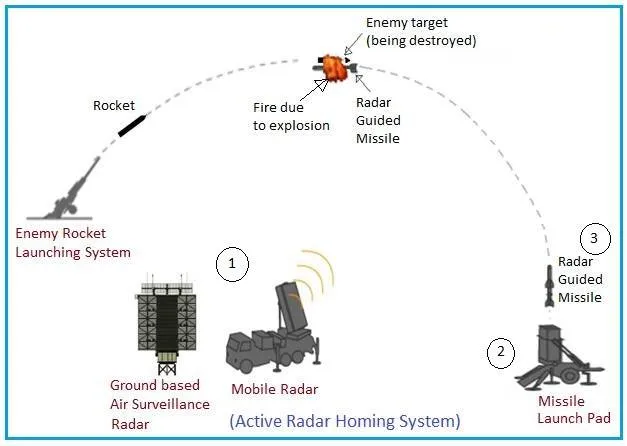 Active Radar Homing Missile System
The image above illustrates the components of an active radar homing system: a fixed or mobile radar, a missile launch pad, and the radar-guided missile.
How it Works
Here’s a breakdown of the active radar homing system’s operation:
- Ground Radar Illumination: The ground radar station continuously emits electromagnetic energy into the air. This energy reflects off of targets that enter its range.
- Target Detection and Missile Launch: Once the ground radar system detects a target at long range, it signals the missile launch pad to release an air-to-air missile towards the target.
- Onboard Radar Activation: As the radar-guided missile approaches the target, it uses its onboard radar transceiver to refine its range and get much closer.
- Target Destruction: Ideally, the air-to-air radar-guided missile detonates near the target, destroying it and any other rockets in the vicinity. Direct hits are also possible.
Advantages of Active Radar Homing
- Increased Accuracy: It’s more accurate than land-to-air missiles guided solely by ground-based radar.
- Proximity to Target: The onboard radar transceiver allows the missile to get very close to the target, significantly increasing the probability of a successful destruction.
- Launch Platform Independence: Once fired, the missile autonomously tracks and destroys the target. This frees up the launch platform to track other targets.
Disadvantages of Active Radar Homing
- Higher Cost: The use of a radar transceiver makes it more expensive compared to semi-active radar homing systems.
- Lower ERP and Limited Range: Because the missile uses battery power for its operation, it has a lower Effective Radiated Power (ERP) and a limited coverage range.
- Reliance on Ground Radar for Long Range Targets: It’s not effective for hitting long-range targets without the initial assistance of a ground-based radar system.
Summary
Active radar homing enables autonomous target tracking using onboard radar systems. Advantages include high accuracy and independence, while disadvantages include complexity, cost, and electronic interference risks.