
What is eFPGA : Advantages and Disadvantages
Advertisement
An embedded FPGA (eFPGA) integrates programmable logic directly into a system-on-chip (SoC), enabling post manufacturing hardware customization. It is used in AI, automotive, aerospace, and communication applications. Advantages include flexibility and reduced development time, while disadvantages include increased chip area, power consumption, and design complexity.
eFPGA Architecture & Comparison with FGPA
eFPGA stands for Embedded FPGA. It’s essentially an FPGA in the form of an IP core, designed to be integrated directly onto an ASIC (Application-Specific Integrated Circuit) or SoC (System on a Chip) to add programmable logic capabilities.
Unlike traditional FPGA chips, eFPGAs don’t include the typical external components like GPIOs (General Purpose Input/Output), SERDES (Serializer/Deserializer), and PHYs (Physical Layer transceivers). These functions are already handled by the host ASIC or SoC.
With eFPGAs, you have control over defining the quantity of LUTs (Look-Up Tables), embedded memory, registers, and DSP (Digital Signal Processing) blocks. You can easily adjust the aspect ratio and the number of I/O ports to fit your specific needs. This allows you to carefully balance power consumption and performance.
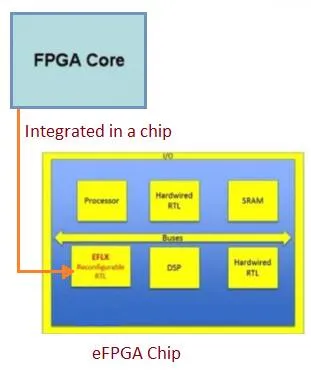
Figure 1: eFPGA on a SoC or ASIC
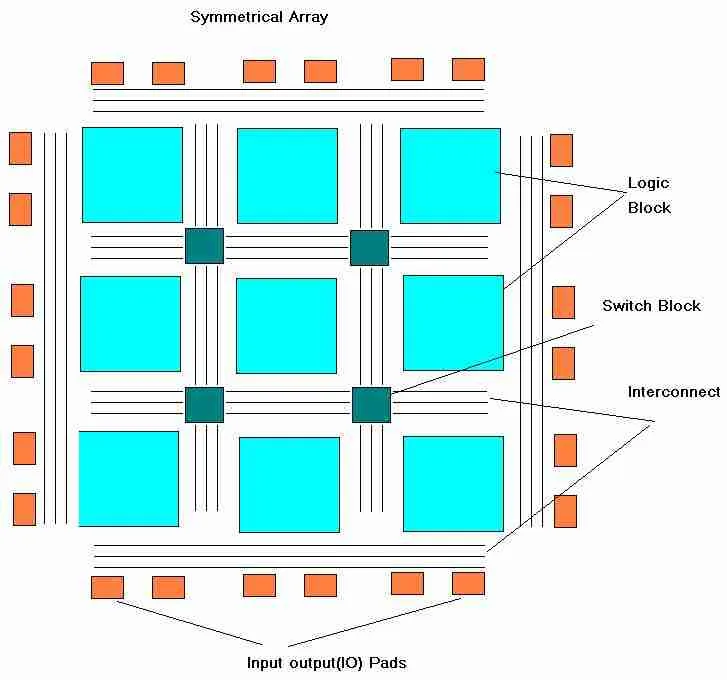
Figure 2: FPGA architecture
Figure 3 (not provided, but conceptually): A visual representation would show the reconfigurable RTL (Register-Transfer Level) which comprises the core of the eFPGA, alongside other SoC components such as a DSP, CPU, SRAM, and hardwired RTL.
The eFPGA IP can be licensed from various vendors and directly incorporated into an ASIC or SoC design. For more in-depth information, refer to resources on FPGA Architecture and the differences between eFPGAs and traditional FPGAs.
Benefits (Advantages) of eFPGA
Here are some key benefits of using eFPGAs:
- High Performance and Low Latency: eFPGAs offer exceptional performance due to their parallel interface with the ASIC. Their wide buses (hundreds of bits) allow them to operate at very high speeds.
- Reduced Power Consumption: Power savings stem from multiple factors. The direct connection to the SoC eliminates the need for programmable I/O buffers. Furthermore, eFPGAs can be scaled in size to precisely match application requirements, avoiding unnecessary overhead.
- Lower Overall System Cost: Using an eFPGA can lead to lower system costs by eliminating the need for specialized PCBs (Printed Circuit Boards) and external components like clock generators, power regulators, and level shifters. They also do away with the need for bulky and heavy packages.
- Greater Flexibility: eFPGAs offer superior flexibility because they can be customized even after production, a feature not available with traditional FPGAs.
- High System Reliability and Yields: eFPGAs contribute to high system reliability and improved manufacturing yields.
Drawbacks (Disadvantages) of eFPGA
Here’s the main downside of eFPGAs:
- Threat to Stand-alone FPGA Vendors: The increasing adoption of eFPGAs in ASIC and SoC designs poses a competitive threat to companies like Xilinx and Intel that primarily offer stand-alone FPGAs.
Summary
eFPGAs bring programmable hardware capabilities into SoCs for adaptable system design. Advantages include flexibility and faster innovation, while disadvantages include resource overhead and implementation challenges.