
UWB Tutorial: Working, benefits, limitations, comparison, Use cases
Advertisement
Introduction : UWB (Ultra Wideband) is a high speed short range wireless technology. UWB is standardized under the IEEE 802.15.4 family. The most relevant updates for modern applications are found in the 802.15.4z amendment, which enhances security and ranging capabilities. This standard mentions three frequency bands viz. below 1GHz, 3 - 5GHz, and 6-10GHz.
While technologies like Wi-Fi and Bluetooth connect us to data, Ultra-Wideband (UWB) connects us to physical space. Unlike “narrowband” technologies that transmit data on a specific frequency (like a radio station), UWB spreads low-energy signals across a massive bandwidth (hence “Ultra-Wide”). This unique characteristic allows it to act as both a communication device and a highly precise radar sensor simultaneously.
UWB Evolutions
- IEEE 802.15.4a: The foundation. It established UWB for communications and basic positioning but lacked security against modern attacks.
- IEEE 802.15.4z: The security update. Driven by the need for secure car access (CCC) and payments, it added cryptography to the physical layer (STS) to prevent distance spoofing.
- IEEE 802.15.4ab: The universal expansion. It transforms UWB into a “Super-Standard” covering Radar Sensing, High Speed Data and Ultra Low Power IoT, fixing the gaps left by previous versions.
UWB Technical Specifications
Following are the specifications of UWB technology as per IEEE 802.15.4z standard. MB-OFDM or Direct Sequence UWB (DS-UWB) Physical layers are defined for UWB.
- Frequency Range : 3.1 GHz to 10.6 GHz
- Bandwidth : Greater than 500 MHz (typically 500 MHz, 1 GHz, or 1.3 GHz modes)
- Pulse Width : ~ 2 nanoseconds (Very Short Duration)
- Modulation : Pulse based
- Update rate : Up to 1000 times per second
- Coverage area : Typically 10-70 meters per anchor
- Data Rate : About 27 Mbps
- Power Consumption : Ultra Low (<10 mWatts for sensing applications)
- Bandwidth: 1.368 GHz and 2.736GHz (for DS-UWB) and 528 MHz for MB-OFDM
- No. of simultaneous piconets: 8 (DS-UWB), 4 (MB-OFDM)
- Security : Includes Scrambled Timestamp Sequences (STS) to prevent spoofing
UWB Block Diagram
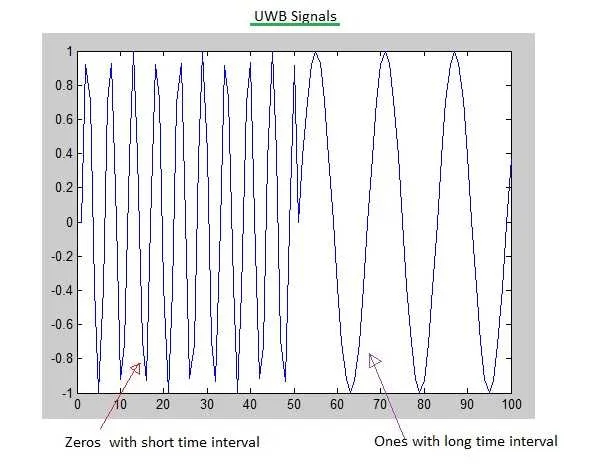
UWB uses a time shifting mechanism to transmit binary data at millions of pulses per second. Here, zero is transmitted at short time intervals and one is transmitted at long time intervals. The UWB waveform is shown in the figure-1 below. The time interval between pulses is used to differentiate binary data digits zero (‘0’) or one (‘1’). This is simple explanation of UWB transmitter and receiver as per IEEE 802.15.4a legacy standard.
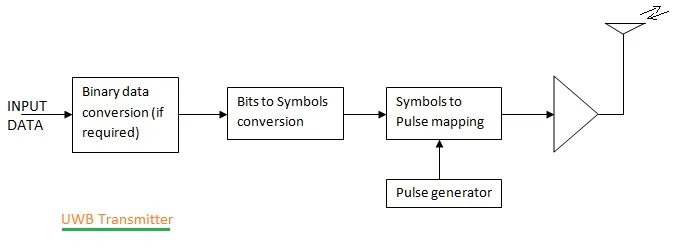
The figure-2 below depicts a UWB transmitter, which consists of a binary data source, conversion of bits to symbols, symbols to pulses using a pulse generator and an RF part.
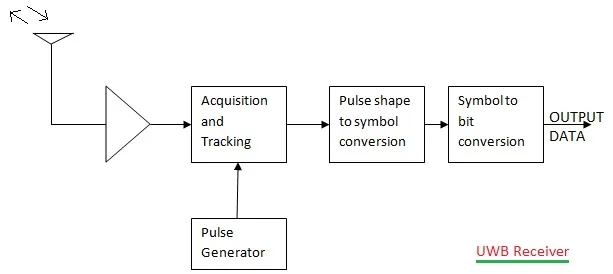
The figure above depicts a UWB receiver consisting of a front end part and symbols to bits conversion. The front end part does acquisition, tracking, and conversion of pulses to symbols. After bits conversion, data conversion takes place based on the application’s needs.
How UWB Works
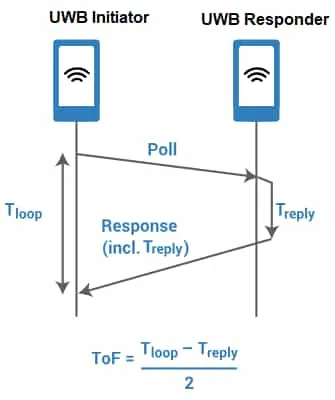
The “magic” of UWB lies in how it measures distance. Unlike Bluetooth or Wi-Fi, which estimate distance based on how strong the signal is (Received Signal Strength Indicator - RSSI), UWB measures Time.
- The Mechanism: Time of Flight (ToF)
- Pulse Transmission: Device A (e.g., a car) sends a specific pattern of radio pulses.
- Reception: Device B (e.g., a key fob) receives the pulses.
- Calculation: The time it took for the signal to travel is measured with extreme precision (nanoseconds).
- Result: Since the speed of light is constant.
Wideband concept of UWB is very useful. Because UWB uses such a wide bandwidth (>500 MHz), it transmits extremely sharp, narrow pulses (2 nanoseconds wide).
It offers multipath Immunity. In a cluttered room, radio signals bounce off walls (multipath). Narrowband signals (Wi-Fi) get confused by these echoes. UWB pulses are so short that the receiver can distinguish the first direct signal from the later bounced reflections. This ensures accuracy even in metal-heavy factories.
Key benefits of UWB
Following are some of the key advantages of UWB technology.
- It offers centimeter level precision. UWB achieves accuracy down to 10 cm, whereas Bluetooth/Wi-Fi typically struggle to get within 1 to 3 meters.
- It offers Low Latency. With update rates under 1 ms, it is fast enough for safety critical applications like collision avoidance in autonomous vehicles.
- It supports dual functionalities. A single UWB chip can perform Secure Ranging (measuring distance) and Radar Sensing (detecting presence/breathing) simultaneously.
- Being a very low power signal, it will not interfere with other wireless systems in the same frequency band. Moreover, battery of UWB devices can last for a longer duration due to low power consumption.
- They can easily penetrate into walls.
Applications & Use cases
- Automotive (V2X and Safety) :
- Digital Keys: Your phone becomes a secure car key that unlocks only when you are within inches of the door handle.
- Child Presence Detection (CPD): UWB radar can detect the micro movements of a sleeping infant’s chest (breathing) inside a locked car, alerting the owner even if the baby is covered by a blanket.
- Vehicle Platooning: Autonomous trucks can drive safely within meters of each other at highway speeds by communicating precise relative positions via UWB.
- Industrial (Smart Factory / Industry 4.0)
- Micro-Location: Tracking tools, forklifts, and AGVs (Automated Guided Vehicles) indoors where GPS fails.
- Safety Zones: Machinery can automatically shut down if a worker’s badge enters a “danger zone” defined by UWB anchors.
- Consumer & Smart Home
- Gesture Recognition: UWB radar can detect hand waves to control lights or audio without touching a device.
- Vital Sign Monitoring: Non-contact monitoring of heart rate and respiration for healthcare wearables or sleep trackers.
- Medicine : These include cardiology, respiratory medicine, obstetrics and Gynecology, in the emergency room and for acute care, assistance for disabled people, throat and vocal cord monitoring, etc.
Comparison with other wireless technologies
Following are some of the comparison factors between UWB and other wireless standards such as Bluetooth, WiFi and mmwave radar with respect to sensing and other parameters.
| Feature | UWB | Bluetooth (BLE) | Wi-Fi (RTT) | mmWave Radar |
|---|---|---|---|---|
| Primary Method | Time of Flight (ToF) | Signal Strength (RSSI) | Time of Flight | FMCW/Doppler |
| Accuracy | High (~10cm) | Low (1-3 meters ) | Medium (~ 1 meter) | High (< 1 cm) |
| Reliability (Interference) | High (Resists Multipath) | Low (Affected by obstacles) | Medium | High |
| Power Efficiency | High (< 10 mWatts) | High | Low | Low (Power Supply) |
| Security | Excellent (Physical Layer Security) | Low (Susceptible to relay ) | Medium | N/A |
| Cost | Low/Medium | Very Low | Low | High |
| Through Walls ? | Yes (Penetrates dry wall/plastic) | Yes | Yes | No (Line of sight mostly) |
Source : Microwave Journal (eBook), Nov. 2025
Limitations of UWB
Following are some of the constraints of UWB.
- Infrastructure Requirement: Unlike GPS which works via satellites, UWB indoor tracking requires the installation of fixed “Anchors” (receivers) around the facility.
- Range: While better than Bluetooth, UWB is a short range technology (typically < 100m). It cannot replace LoRa or Cellular for long distance tracking.
- Blind Zones: In monostatic radar configurations, energy leakage between transmit and receive antennas can create a small “blind zone” very close to the device.
Comparison between various UWB versions
| Feature Category | IEEE 802.15.4a (Legacy) | IEEE 802.15.4z (Secure Ranging) | IEEE 802.15.4ab (Next Gen) |
|---|---|---|---|
| Primary Focus | Basic data transfer and Location | Security and Ranging Accuracy (Fine Ranging) | Sensing, Extreme data rates & Ultra Low Power |
| PHY modes | BPRF (Basic Pulse Repetition Frequency) | BPRF and HPRF (High Pulse Repetition Frequency) | HRP-EMDEV (Enhanced Modulation), HRP-SDEV (Sensing), LE-UWB |
| Max. data rates | ~27 Mbps | ~27-31 Mbps | 124.8 Mbps (High Speed HPRF) |
| Long Range Support | Standard Link Budget | Standard Link Budget | MMS Ranging (Multi-Millisecond) & Long Symbol Mode (512 ns) |
| Ranging Security | None (Vulnerable to preamble injection) | STS (Scrambled Timestamp Sequence) & Distance commitment | MMS with RIF (Ranging Integrity Fragments) & Narrowband Assiatance |
| Sensing/Radar | Proprietrary implementations, not part of standard | Proprietrary implementations | Native support (HRP-SDEV), Frequency Stitching & Specific Sensing Packets |
| Pulse Shapes | Root Raised Cosine (RRC) - Communications | 8th order butterworth - Ranging | Time Bounded Kaiser Window - Sensing (Zero Sidelobes) |
| Power Management | Standard Sleep Modes | Standard Sleep Modes | WUB (Wake-Up Radio) & LE-UWB (Non-coherent, no PLL) |
| Error Correction | Reed Solomon (RS)/Convolutional encoder/decoder | Reed Solomon (RS)/Convolutional encoder/decoder | LDPC (Low-Density Parity-Check) for dynamic rate adaptation |
| Control Channel | In-band UWB only | In-band UWB only | Narrowband (NB) Assistance (2.4/5/6 GHz O-QPSK) |
| Key use cases | Industrial tags, basic RTLS | Digital Car Keys, Mobile Payments, Secure Building Access | Lossless Audio, Gesture Control, Child Presence Detection, Coin-cell Tags |
Summary: UWB is used to power next generation of smart devices. By moving beyond simple data transfer and enabling devices to understand micro-location and presence, UWB solves problems that GPS and Bluetooth can not solve. UWB provides the secure, precise, and real time data necessary for critical decision making in the automated world.