
LTE PUCCH: Physical Uplink Control Channel Explained
Advertisement
This page describes the LTE PUCCH (Physical Uplink Control Channel) within the LTE system. This LTE channel is used to carry UCI (Uplink Control Information).
UCI can also be transported using the PUSCH channel.
An LTE UE (User Equipment) can never transmit both PUCCH and PUSCH during the same subframe.
- If the UE has application data OR RRC signaling, then UCI is carried over PUSCH.
- If the UE does not have any application data OR RRC signaling, then UCI is carried over PUCCH.
This is a stand-alone uplink physical channel.
This PUCCH control signaling channel comprises the following:
- HARQ ACK/NACK (Hybrid Automatic Repeat Request Acknowledgement/Negative Acknowledgement)
- CQI (Channel Quality Indicators)
- MIMO feedback - RI (Rank Indicator), PMI (Precoding Matrix Indicator)
- Scheduling requests for uplink transmission
- BPSK or QPSK used for PUCCH modulation
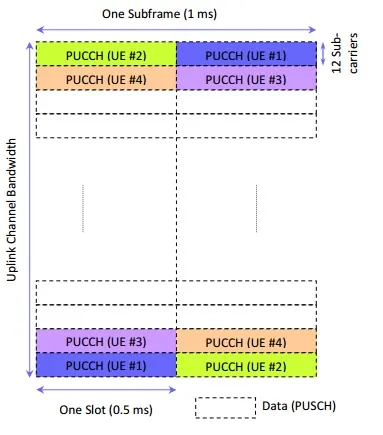 LTE PUCCH channel
PUCCH consists of 1 RB (Resource Block) per transmission at one end of the system bandwidth, which is followed by another RB in the following slot (at the opposite end of the channel spectrum). This utilizes frequency diversity with an estimated gain of 2dB.
A PUCCH Control Region comprises every two such RBs.
| System BW in MHz | 1.25 | 2.5 | 5 | 10 | 15 | 20 |
|---|---|---|---|---|---|---|
| PUSCCH Control region | 1 | 2 | 4 | 8 | 12 | 16 |
| No. of resource blocks | 2 | 4 | 8 | 16 | 24 | 32 |
The standard specifies 6 LTE PUCCH formats, as mentioned in the table below.
As mentioned, PUCCH format 2a and 2b are not applicable for extended CP (Cyclic Prefix).
| LTE PUCCH Format | Modulation | Index | No. of bits per subframe | No. of REs occupied(Normal CP) | No. of REs occupied(Extended CP) |
|---|---|---|---|---|---|
| 1 | - | - | - | 48+48=96 OR 48+36=84 | 48+48=96 OR 48+36=84 |
| 1a | BPSK | 1 | 1 | 48+48=96 OR 48+36=84 | 48+48=96 OR 48+36=84 |
| 1b | QPSK | 2 | 2 | 48+48=96 OR 48+36=84 | 48+48=96 OR 48+36=84 |
| 2 | QPSK | 20 | 120 | ||
| 2a | QPSK+BPSK | 21 | 120 | Not Applicable | |
| 2b | QPSK+QPSK | 22 | 120 | Not Applicable |
Table-2 LTE PUCCH Formats
| LTE PUCCH Format | No. of bits per subframe | Normal CP | Extended CP |
|---|---|---|---|
| 1 | - | Scheduling Request | |
| 1a | 1 | 1 x HARQ-ACK OR | 1 x HARQ-ACK +SR |
| 1b | 2 | 1 x HARQ-ACK +SR | 2 x HARQ-ACK +SR |
| 2 | 20 | 2 x HARQ-ACK +SR | |
| 2a | 21 | CQI CQI OR HARQ-ACK+CQI | |
| 2b | 22 | 1 x HARQ-ACK + CQI | - |
| HARQ-ACK + CQI | 2 x HARQ-ACK + CQI | - |
Table-3 Information carried by each PUCCH format
The LTE PUCCH channel is allocated 2 RBs at the edges of the channel BW. Each PUCCH transmission occupies 1 RB on each side of the channel bandwidth. These two RBs are distributed across two time slots. RB numbering for PUCCH starts on the outside edges and increases inwards.
PUCCH is allocated RBs at the edge of the channel BW to avoid fragmenting RBs available to PUSCH.
- ** LTE PUCCH Channel Reference:** 3GPP TS 36.211
Explore More LTE Channels
- LTE PBCH Physical Broadcast Channel
- LTE PCFICH Channel : Physical Control Format Indicator Channel
- LTE PDCCH : Physical Downlink Control Channel
- LTE PDSCH Channel : Physical Downlink Shared Channel
- LTE PHICH: Physical Hybrid ARQ Indicator Channel
- LTE PMCH : Physical Multicast Channel
- LTE PRACH Channel: Physical Random Access Channel
- LTE PUSCH: Physical Uplink Shared Channel
- LTE PSS vs SSS: Primary and Secondary Synchronization Signals
- LTE Reference Signals: RS, DMRS, and SRS
Continue Learning 4G LTE
- 4G LTE Basics Tutorial
- 4G LTE Architecture: Network Elements and Interfaces
- LTE Frame Structure
- LTE Channel Types: Logical, Transport and Physical Channels
- LTE Protocol Stack: User Plane vs. Control Plane
- 4G LTE Physical Layer & its modules
- LTE Frequency Bands: FDD, TDD and E-UTRA Bands
- LTE Carrier Aggregation & its benefits
- 4G LTE Network Security
- LTE Cell Search Procedure
- LTE UE Uplink Network Entry : Random Access Procedure
- LTE Paging Procedure Mechanism and Call Flow