
What is SRAM: Advantages and Disadvantages
Advertisement
Static Random Access Memory (SRAM) is a high speed semiconductor memory that stores data using bistable flip flop circuits without requiring periodic refresh cycles. Its advantages include fast access time and low latency, while its disadvantages include higher manufacturing cost, larger cell size, and lower storage density than DRAM.
Introduction
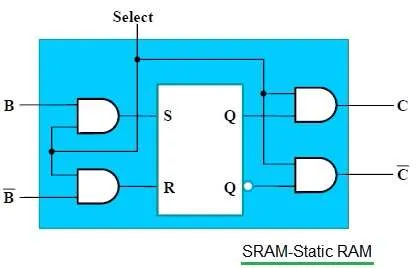
- SRAM uses an array of storage cells.
- Information is stored in devices known as latches, usually SR latches.
- It is used in computers, mobile phones, automotive electronics, electronic toys, etc.
Benefits or Advantages of SRAM
- SRAM performance is better than DRAM in terms of speed. It is faster in operation. As a result, it takes less time for accessing data or information compared to DRAM.
- It is used to create speed-sensitive cache.
- It has medium power consumption.
Drawbacks or Disadvantages of SRAM
- It is costlier compared to DRAM.
- It is volatile, meaning data is lost when memory is not powered.
- It is not possible to refresh programs.
- It has low storage capacity.
- SRAM has a more complex design.
Summary
SRAM provides exceptionally fast memory performance for processor caches, networking equipment, and high-speed embedded systems where rapid data access is essential. Its speed advantages greatly enhance computing performance, although higher cost and lower storage capacity influence memory architecture decisions.