
What is SDH: 5-10 Advantages and Disadvantages
Advertisement
SDH (Synchronous Digital Hierarchy) is a standardized optical transmission technology used to transport large volumes of digital data over fiber optic communication networks. Its advantages include high reliability and simplified network synchronization, whereas its disadvantages include expensive infrastructure and lower flexibility compared with modern packet-based networking technologies.
Key Features of SDH
- SDH is the short form of Synchronous Digital Hierarchy.
- This term is used in digital multiplexers installed in telephone exchanges.
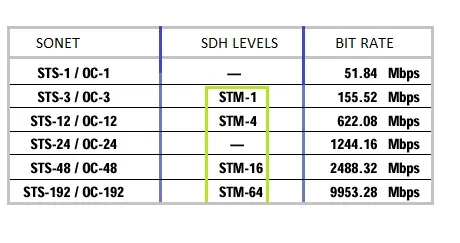
- It is a European standard similar to SONET, which is an American standard.
- It supports different topologies, viz., point-to-point, star, ring, etc.
- It multiplexes inputs having the same bit rate and derived from a common clock source. Hence, the name “synchronous.”
- Word interleaving is used to combine signals.
Benefits or Advantages of SDH
- A more simplified multiplexing and demultiplexing technique.
- Synchronous networking, and SDH supports multipoint networking.
- Capability of transporting existing PDH signals.
- Easy growth to higher bit rates, which enhances the administration and maintenance process.
- It is capable of transporting broadband signals.
- It is multivendor and supports different operators.
- It provides network transport services on LAN such as video conferencing and interactive multimedia.
- Optical fiber bandwidth can be increased without limit in SDH.
- Switching protection to traffic is offered by rings.
- SDH allows quick recovery from failure.
Drawbacks or Disadvantages of SDH
- It offers a lower bandwidth utilization ratio compared to PDH due to the many OH bytes used for OAM (Operations, Administration, and Maintenance).
- Direct adding/dropping of lower-rate signals is achieved using pointers. This increases the complexity of the system.
- Software is used largely in the SDH system. Hence, it is vulnerable to computer viruses.
- It requires complicated SDH equipment due to a variety of management traffic types and options.
- It cannot carry E2 due to the unavailability of a container.
Summary
SDH has served as a dependable backbone technology for carrier grade optical communication by providing synchronized, high capacity, and fault tolerant data transport. Its operational advantages continue to support legacy telecommunications infrastructure, although packet-based technologies now offer greater scalability and flexibility.