
Radar Range Calculator and formula
Advertisement
Understanding how far a radar system can detect a target is a critical performance metric in applications ranging from air traffic control to weather monitoring and defense systems. At the heart of this lies the radar range calculation using transmit and receive power, a scientific method that connects the energy a radar emits with the faint echoes it receives back from distant objects. This radar range calculator uses formula with transmit power and antenna characteristics to calculate maximum operational detection range of the radar.
Radar Range Calculator
INPUTS:
- Transmit pulse power (peak), watt = 2.5e6
- Gain = 25
- Radar cross section = 1 m^2
- Antenna aperture (meter) = 25
- MDS = 110
OUTPUT:
- Maximum Radar Range = 32.6 meters
In a radar system, the range to a target is readily determined by analyzing the received power of the echo signal.
A simplified equation to illustrate this is:
Pr = Pt / (4 * PI * r^2)
Where:
Pris the received power.Ptis the peak transmit power.ris the distance of the target from the radar (i.e., the radar range).
This equation assumes an isotropic antenna. For a directional antenna, we use a slightly different formula, as shown below and used in the radar range calculator.
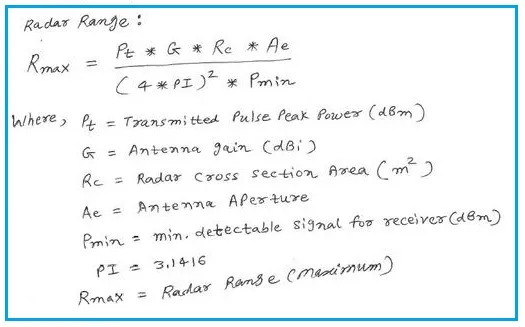
Maximum Radar Range Calculator
Another equation for determining the maximum radar range is presented below.
EXAMPLE:
- Assumption: T = 300 Kelvin and K = 1.38e-23
INPUTS:
- Freq(GHz) = 5
- Antenna Diameter = 5 meters
- Radar cross section = 1 m^2
- Peak pulse power = 2.5e6
- Receiver BW (MHz) = 1.6
- NF = 12dB
OUTPUT:
- Maximum Radar Range = 550 Km
Radar Range formula
Maximum radar range can also be calculated using the following radar equation:
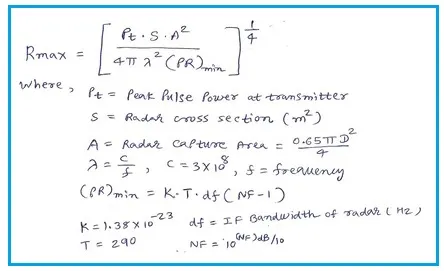
- The radar equation shows that received power falls off rapidly with distance to the fourth power of range.
- Both transmit and receive antenna gains directly influence the power budget. Higher gain antennas concentrate energy more effectively, boosting both the transmitted beam and the sensitivity to weak echoes without increasing raw power.
- The radar cross section tells how much energy a target reflects. Larger or more reflective targets return stronger echoes, improving detection distance for the same transmit power.
Summary: Radar range calculation using transmit and receive power ties together fundamental principles of electromagnetics, antenna theory and real world system limitations. By understanding how transmit power interacts with receive sensitivity through the radar equation, engineers and enthusiasts unlock the ability to quantify detection limits, optimize designs and predict performance in diverse environments.