
What are RF Filter Applications in Microwave Communication
Advertisement
RF filter applications in microwave communication are essential for isolating desired frequencies and eliminating unwanted signal interference. These filters including low pass, high pass, band pass, and band stop types ensure clear data transmission across high frequency networks. Primary applications involve cellular base stations, satellite communications, radar systems, and wireless broadband networks, where they optimize bandwidth utilization and protect sensitive receivers from out-of-band noise.
What is RF Filter and its types
RF filters are crucial for filtering and managing frequency content in various industries. They are used in both analog and digital circuits. Analog filters, made of analog components, are found in analog circuits. These filters come in two types: active and passive. Passive filters consist of inductors (L), capacitors (C), and resistors (R), while active filters incorporate op-amplifiers in addition to L/C/R.
Digital filters are developed using programming languages like MATLAB and C and are implemented in digital components such as ASICs, processors, or FPGAs. The programs for digital filters are flashed onto these components.
RF filters are of the analog type and are constructed using microstrip, stripline, or other types of transmission lines. These lines can be transformed into the basic L, C, and R components.
The following section outlines the core applications, functions, and use cases where RF filters are employed.
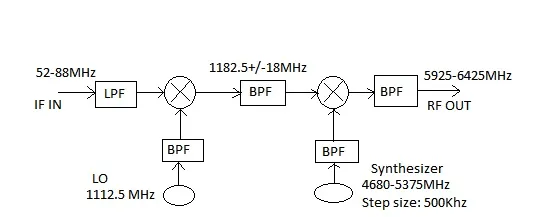 RF filter
RF Filter Applications and Uses
-
IF Filtering: As shown in the figure, IF filters are used to allow intermediate frequencies (IF) of 1182.5 +/- 18 MHz to pass through using a Band-Pass Filter (BPF). This eliminates other nearby IF frequencies that may mix with the Local Oscillator (LO) frequency, producing frequencies in the desired C band and causing interference if present.
-
Low-Pass Filtering: A Low-Pass Filter (LPF) is used to pass lower IF frequencies in the range from 52 to 88 MHz.
-
RF Band Filtering: An RF filter in the higher band from 5925 to 6425 MHz is used to pass frequencies only in the C band. This avoids nearby interference from other satellite bands.
-
Broadcast Receivers: RF filters are used in broadcast receivers to select the desired channel frequency and reject all other frequency channels.
-
Image Frequency Rejection: They are used for image frequency rejection in radio and TV receivers, as well as satellite receivers.
-
Multi-Way Loudspeakers: Filters are also used in multi-way loudspeakers, where different audio frequencies are distributed to different loudspeakers designed for high, bass, and mid-range tones.
-
EMI Filters: EMI filters are used for noise reduction.
-
LO Leakage Prevention: They are also used to stop Local Oscillator (LO) leakage in RF transceiver designs.
Summary
RF filters act as the backbone of microwave communication, ensuring superior signal integrity by blocking interference and expertly managing frequency allocation. Their strategic application across satellite and cellular systems is strictly vital for high speed, noise free wireless data transmission.