
What are FET and PIN Diode RF Switches : Explain circuits with working
Advertisement
FET and PIN diode RF switches are solid-state devices used for rapid signal routing. A PIN diode switch works by changing its resistance based on forward or reverse DC bias, blocking or passing RF signals. Conversely, a FET switch controls RF signal flow by varying the voltage applied to its gate, offering ultra-fast switching speeds and low power consumption.
RF switches based on FET and PIN diodes are essential for controlling signals in RF circuits. These switches operate on distinct principles, offering low loss and high isolation.
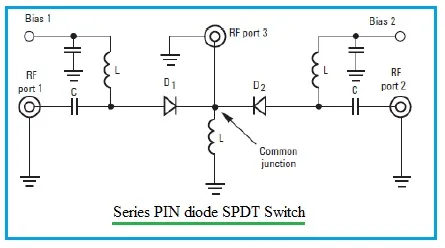
PIN Diode SPDT RF Switch
-
PIN diode is a semiconductor device which functions as a variable resistor at RF & microwave frequencies.
-
The PIN diode resistance is less than 1 Ohm in the ON state. It is more than 10 K-Ohm in the OFF state. It depends on the amount of current flow through the PIN diode. It is a current controlled device; hence the resistance depends on the forward-biased DC current only.
-
PIN diodes can be used for switching based on ON/OFF control current through it.
-
PIN diodes can control large amplitude RF signals with the help of a much lower level of DC excitation.
-
PIN diode resistance in forward bias condition is inversely proportional to total forward bias current. This makes the PIN diode perfect for achieving excellent isolation at higher frequencies.
-
Figure 1 depicts a PIN diode based SPDT RF Switch.
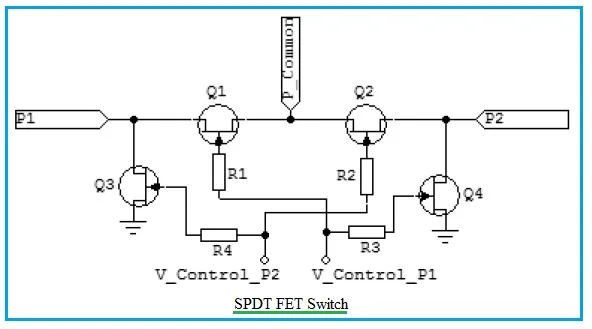
FET based RF Switch
-
To switch RF from the common port to port-2, Q1/Q4 are reversed biased. Due to this, the channel between the drain (D) and source (S) terminals is pinched off. At the same time, Q2/Q3 are forward biased such that low channel resistance exists between the source (S) and drain (D) terminals.
-
The FET transistors Q1 & Q3 act as series devices to switch RF to the ON and OFF conditions. For better isolation, FET transistors Q3 & Q4 are used to shunt RF to the ground which leaks to the OFF port of the switch.
-
More FETs are added in series on each arm of the RF Switch to increase isolation and linearity.
-
Figure 2 depicts a FET-based SPDT RF Switch.
Conclusion
Both FET and PIN diode RF switches offer distinct advantages for high speed, reliable microwave signal routing in modern telecommunications. Choosing between them depends strictly on your circuit’s requirements for power handling, switching speed and insertion loss.