
What is Tilt Switch and Sensor: Types, Working, Advantages and Disadvantages
Advertisement
A tilt switch or tilt sensor is an electronic device that detects changes in orientation or inclination by monitoring the position of an internal sensing element. Its advantages include simple operation, low power consumption, and reliable motion detection, whereas its disadvantages include limited measurement precision, mechanical wear in some designs, and sensitivity to vibration.
Tilt Switch Types and working operation
- Both tilt switches and tilt sensors serve the same function: to detect tilt or inclination. They become ON or OFF based on the degree of tilt.
- A tilt switch is an electromechanical switch, while a tilt sensor is an electronic device.
- Tilt sensors are classified as single axis/single output, dual axis/dual output, and dual axis/single output.
- Most tilt switches are SPST (Single Pole Single Throw) type, either normally open or normally closed.
- Mercury-based tilt switches are the oldest type, utilizing mercury’s excellent electrical conductivity. These switches use a blob of mercury in a glass bulb. When the bulb is tilted, the mercury makes contact with two leads, allowing current to flow when the switch is connected in series with a battery.
- Due to environmental hazards and regulations, mercury-based tilt switches are increasingly replaced by ball type tilt switches or tilt sensors.
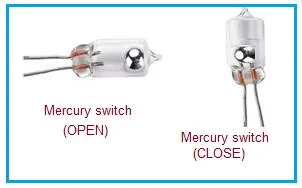
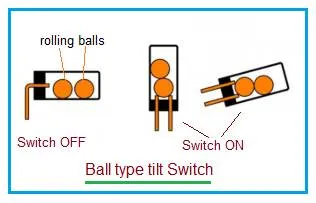
Figure 1 depicts both mercury type and ball type tilt switches. The advantages and disadvantages vary depending on the specific type of tilt switch or sensor.
Benefits/Advantages of Tilt Switches/Sensors
- Mercury-based tilt switch:
- Low cost and easy to use.
- Very long operating life.
- Low resistance and quiet operation.
- Ball-type tilt switch:
- Offers multiple contacts, allowing determination of tilt direction.
- Less toxic compared to mercury switches.
- General Advantages:
- Very small in size.
- Consume low power.
- Durable when used properly.
- Easy to interface with microcontrollers for various analyses with simple code.
Drawbacks/Disadvantages of Tilt Switches/Sensors
- Mercury-based tilt switch:
- Mercury is hazardous due to its toxicity.
- Ball-type tilt switch:
- Arcing may erode the contacts when the switch is subjected to current above its rated specification, reducing reliability.
- Vibration of the balls can create erratic or random signals.
- General Disadvantages:
- Require gravity to operate (to roll a ball or move a blob of mercury). Therefore, they will not work under low gravity, reversed gravity, or zero gravity conditions.
- Performance in vehicles that accelerate or decelerate suddenly may be unreliable.
- Deliver erroneous results under significant vibration conditions.
Summary
Tilt switches and sensors are widely used in safety systems, consumer electronics, industrial automation, robotics, and vehicle monitoring for orientation detection and motion control. Their sensing advantages provide dependable operation with simple circuitry, although precision requirements, vibration effects, and sensor selection should be matched to the intended application.