
What are Radio Frequency (RF) Waves: Advantages and Disadvantages, Uses
Advertisement
Radio Frequency (RF) waves are electromagnetic waves used to transmit wireless signals for communication, navigation, sensing, and broadcasting across a wide range of frequencies. Their advantages include long distance wireless transmission and broad application versatility, whereas their disadvantages include interference, spectrum congestion, and propagation losses under certain conditions.
Introduction : Radio Frequency (RF) waves are electromagnetic (EM) waves that fall within the frequency range of 30 KHz to 300 GHz. Different portions of this RF spectrum, often called bands, are designated for particular uses and technologies. Governments typically approve and regulate the RF spectrum, and portions are often sold to private cellular network providers under specific agreements.
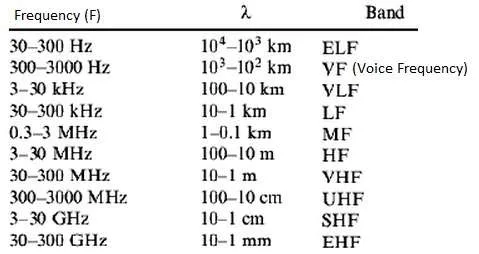
The table mentions various radio frequency bands up to 300 GHz.
Applications of RF(Radio Frequency)
- RF waves are widely used for wireless communication, including radio and TV broadcasting, cell phones, Wi-Fi, Bluetooth, and satellite communication.
- Radio frequency is used in radar for detecting and tracking objects. Radar systems emit RF waves and analyze the reflected signals to determine the distance, speed, and location of objects.
- Microwave ovens utilize RF waves at a specific frequency (around 2.45 GHz) to heat and cook food.
- RFID (Radio-Frequency Identification) employs RF waves to identify and track objects, people, or animals. This is commonly used in inventory management, access control systems, and contactless payment systems.
- RF energy is used in medical devices like MRI machines and RF ablation procedures to treat specific medical conditions.
- RF frequencies find use in remote sensing applications, such as Earth observation and weather monitoring. Satellites are equipped with RF sensors to gather data on weather patterns and environmental conditions.
- RF energy is used in industrial heating processes, scientific research, and materials testing.
Advantages of Radio Frequency (RF)
- Penetration Capability: RF waves have varying penetration capabilities through walls and objects, depending on the frequency. This makes them suitable for radio and television transmission, as well as cellular mobile phone service.
- Wireless Communication: RF technology enables wireless communication, facilitating data exchange without the need for physical connections.
- Ease of Installation: RF devices are generally easy to install and set up.
- Cost Effectiveness: RF technology can be cost effective, especially in situations where installing wired connections would be expensive or impractical.
- Remote Monitoring and Control: RF based sensors and telemetry systems enable remote monitoring and control of equipment and processes, reducing the need for physical presence.
- Low Latency: RF waves support low latency data transfer, making them suitable for real time communication such as voice calls and online gaming.
- Energy Efficiency: Low-power RF protocols are used in IoT devices, which are designed for energy efficiency to extend battery life.
Disadvantages of Radio Waves
- Interference: RF signals are susceptible to interference from other electronic devices, potentially reducing signal quality and reliability.
- Limited Range: RF signals have a limited range, which means they might not be suitable for long-distance communication without the use of repeaters.
- Limited Spectrum: The RF spectrum is limited, leading to competition for available frequency bands.
- Security Concerns: RF waves can be intercepted or jammed, posing security risks in applications like wireless communication and RFID. Secured algorithms (AES, WEP, WPA), encryption techniques, and modulation techniques (such as FHSS) are employed to avoid eavesdropping.
- Line of Sight (LOS) Requirements: RF communication systems often require a clear LOS between the transmitter and receiver.
- Attenuation: RF signal waves get attenuated or weakened as they pass through materials such as walls, foliage, and even the atmosphere. This attenuation can limit signal range and strength.
- Frequency Crowding: As more wireless devices and services use the RF spectrum, there’s a risk of frequency crowding, which can lead to interference and reduced performance.
- Power Consumption: RF transmitters and receivers can consume significant power, which can be a concern for battery powered devices such as mobile phones and IoT sensors.
- Regulations and Licensing: RF technology is subject to regulations and licensing in many regions, which can add complexity to its implementation.
- Potential Health Risks: There are ongoing concerns and debates about potential health risks associated with long term exposure to RF radiation, although scientific studies haven’t conclusively established any harmful health effects from typical RF exposure levels.
Summary
Radio Frequency (RF) technology offers significant advantages, including wireless communication for voice, data, and the internet, versatility across various applications and industries, and the ability to support mobility, scalability and real time communication. However, it’s crucial to be aware of its disadvantages, such as susceptibility to interference, limited range, and security concerns. As RF technology continues to evolve, particularly with increasing integration into the Internet of Things (IoT) and 5G networks, addressing these challenges will be key.