
What is LoRaWAN : 10 Advantages and Disadvantages
Advertisement
LoRaWAN (Long Range Wide Area Network) is a low-power wireless communication protocol designed for IoT devices requiring long range connectivity and extended battery life. It operates over unlicensed frequency bands and supports large scale deployments. Advantages include low power consumption and wide coverage, while disadvantages include low data rates and limited bandwidth.
LoRaWAN Network Architecture & Features
- LoRa technology is utilized as a WAN, hence the name LoRaWAN.
- LoRa stands for Long Range Radio.
- The technical specifications are published by the LoRa Alliance.
- It is a low-power wide-area network (LPWAN) that has gained popularity due to its low power consumption and long coverage range.
- It operates in the 902 to 928 MHz band in the US, 863 to 870 MHz in Europe, and 779 to 787 MHz in China.
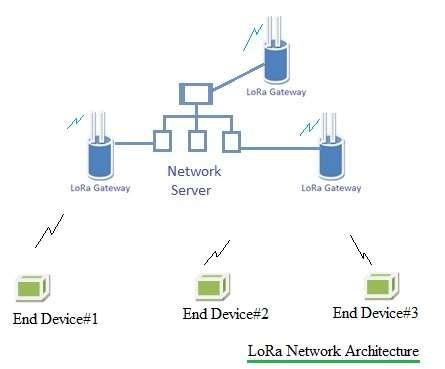 Figure-1 : LoRaWAN Network Architecture
As shown in the figure, LoRaWAN consists of LoRa Gateway, servers and LoRa End Devices.
Advantages of LoRaWAN
- Global Availability: It uses the 868 MHz/915 MHz ISM bands, which are available worldwide.
- Wide Coverage Range: Offers a very wide coverage range, approximately 5 km in urban areas and 15 km in suburban areas.
- Low Power Consumption: Consumes less power, resulting in longer battery life for end devices.
- Scalability: A single LoRa Gateway device can support thousands of end devices or nodes.
- Ease of Deployment: Simple architecture makes it easy to deploy.
- Adaptive Data Rate (ADR): Uses ADR to dynamically adjust the output data rate/RF output of end devices. This maximizes battery life and overall network capacity. Data rates can range from 0.3 kbps to 27 Kbps for a 125 KHz bandwidth.
- Ideal for M2M/IoT: Widely used for Machine-to-Machine (M2M) and Internet of Things (IoT) applications.
- Robust Modulation: The physical layer uses robust Chirp Spread Spectrum (CSS) modulation.
- Spreading Factors: Employs 6 Spreading Factors (SF) from SF 7 to 12, enabling orthogonal transmissions at different data rates.
- Processing Gain: Provides processing gain, which allows for reduced transmitter output power while maintaining the same RF link budget, thus increasing battery life.
- Cost-Effective Modulation: Uses LoRa modulation, which has a constant envelope modulation similar to FSK. This allows for the use of low-cost, low-power, and highly efficient Power Amplifier (PA) stages.
- Device Class Support: LoRaWAN supports three different device classes: Class A, Class B, and Class C.
Disadvantages of LoRaWAN
- Limited Data Rate: Suitable for applications requiring low data rates, up to approximately 27 Kbps.
- Duty Cycle Limitations: Network size is limited by a parameter called the duty cycle, which defines the percentage of time a channel can be occupied. This regulation can be a key limiting factor for traffic served in the network.
- Not Suitable for Real-Time Applications: Not ideal for real-time applications that require low latency and bounded jitter.
Summary
LoRaWAN enables long range, low power IoT communications. Key advantages include extended battery life and wide area coverage, while disadvantages include low throughput and higher latency for data intensive applications.
Advertisement


