
What is Six Stroke Engine : 5 Advantages and Disadvantages
Advertisement
A six stroke engine is an advanced internal combustion engine that adds two extra strokes to the conventional four stroke cycle for improved efficiency and reduced fuel consumption. Advantages include better thermal efficiency and lower emissions, while disadvantages include higher complexity, increased cost and limited commercial adoption.
Key Features of 6 stroke engine
The 6-stroke engine builds upon the design of the more common 4-stroke engine. The aim? To boost efficiency, slash emissions, and sip fuel more conservatively.
- It works through six distinct cycles, featuring two power strokes for increased output.
- Six-stroke engines are generally classified into single-piston and opposed-piston designs.
- A key characteristic is the delivery of greater power and torque compared to their 4-stroke counterparts.
- The engine benefits from two expansion (power) strokes within its six-stroke sequence.
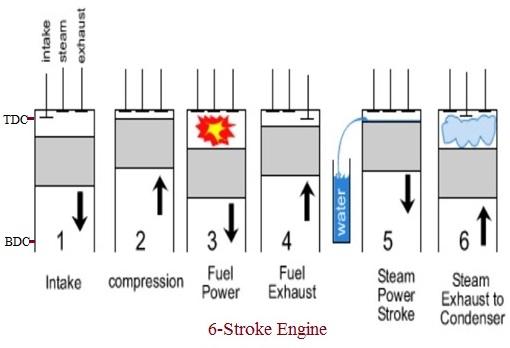
Figure 1: Illustration of the cycle in a 6-stroke engine.
Advantages of Six Stroke Engine
Here’s a breakdown of the benefits offered by Six-stroke engine:
- Increased Power Output: Expect a roughly 35% increase in power compared to a traditional 4-stroke engine.
- Reduced Emissions: Air pollution can be reduced by as much as 65% due to cleaner combustion.
- Improved Thermal Efficiency: The engine makes better use of the heat generated during combustion.
- Lower Fuel Consumption: Fuel consumption sees a significant reduction, potentially as high as 40% compared to a 4-stroke engine.
- Lower Engine Temperature and Noise: Experience reduced engine temperature and quieter operation.
- Enhanced Cooling System: Improved air intake aids the cooling process, potentially eliminating the need for external cooling systems.
- Increased Output Torque: Torque sees a boost of around 35% compared to the 4-stroke engine.
Disadvantages of Six Stroke Engine
Following are some of the drawbacks of Six-Stroke Engine.
- Modification Requirements: Implementing a 6-stroke design often necessitates significant modifications to existing 4-stroke engines.
- Risk of Water Contamination: There’s a possibility of water entering the fuel system.
- Lower Per-Cylinder Power: Brake power and indicated power per cycle per cylinder can be lower.
- Increased Engine Size: The addition of components increases the overall size of the engine.
- Higher Manufacturing Cost: The more complex design and additional parts lead to higher production costs.
Summary
A six-stroke engine improves efficiency by adding two additional strokes to the combustion cycle. Advantages include reduced fuel consumption, while disadvantages include greater mechanical complexity and cost.
Advertisement


