
What is Smart Dust : Applications, Advantages, Disadvantages
Advertisement
Smart Dust is a network of tiny wireless microelectromechanical sensors (MEMS) that can detect, process and transmit data about environmental conditions such as temperature, light, vibration and motion. Smart Dust technology enables real time monitoring in healthcare, industrial automation, agriculture, military surveillance and smart cities, offering scalable sensing capabilities with minimal human intervention.
What is Smart Dust?
Smart dust refers to a device comprising sensing, computing, and wireless communication components, along with a power supply. These devices are typically millimeters in size and designed to be very low cost.
The primary function of smart dust is to monitor real world phenomena. This technology utilizes tiny wireless sensors, often called “motes.” These motes can communicate with each other and collect data as needed.
Features of Smart Dust Technology
- Miniature Size: Approximately the size of a grain of sand.
- Integrated Functionality: Includes sensors, bi-directional wireless communication, computational ability, and a power supply.
- MEMS-Based Design: Employs a series of circuits and Micro-Electro-Mechanical Systems (MEMS) designs to integrate functionalities into a silicon chip.
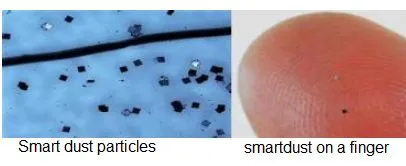
Smart Dust Components and Functions
The construction of a smart dust device involves several key components working together:
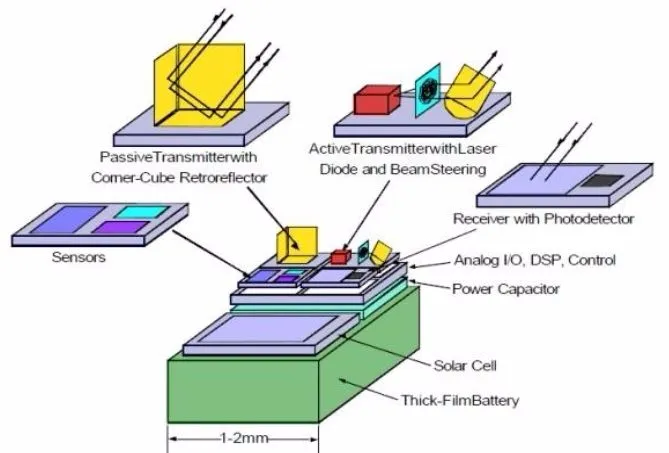
- Sensors: Responsible for detecting various environmental parameters.
- Active Optical Transmission: Uses a laser diode and beam-steering for device-to-device communication.
- Passive Optical Transmission: Employs a corner cube retro-reflector for transmission to base stations (BSs).
- Optical Receiver: Uses a photodetector to receive incoming signals.
- Analog I/O, Signal Processing, and Control Circuitry: Includes a Digital Signal Processor (DSP) or micro-controller for data processing and control.
- Power Source: Can be either solar cells or thick-film batteries.
As illustrated in the diagram above, smart dust utilizes both active and passive transmission methods:
- Active Transmission: Employs a laser diode and steerable mirrors for communication between individual motes.
- Passive Transmission: Uses a corner cube retro-reflector for transmitting data to base stations.
How Smart Dust Works
- Microcontroller Unit (MCU): The smart dust device is controlled by an MCU, which determines the tasks that need to be performed by the mote. It manages the power supply to different components, conserving energy when possible.
- Sensor Input: The MCU receives signals from the sensor, which measures parameters such as light, temperature, vibration, pressure, or acceleration.
- Data Processing: The MCU processes the sensor data according to the sensor type and stores the results in memory.
- Optical Receiver: The device uses an optical receiver to detect incoming communications from other motes or base stations, which may include new programs or messages.
- Transmission: Based on the received message, the microcontroller uses either the corner cube reflector or the laser device to transmit sensor data or messages to a base station or another mote.
Smart Dust Applications
Smart dust technology has a wide array of potential applications:
- Soldier Wearable Shooter Localization Systems: Used to track the location of soldiers in the field.
- Biological Monitoring: Monitors the movements and internal processes of insects or other small creatures.
- Remote Sensing: Useful in environments where wired sensors are impractical, such as rotating machinery or wind tunnels.
- Precision Agriculture: Optimizes fertilization management for farmers, potentially reducing time and increasing productivity.
Advantages of Smart Dust Technology
- Small Size: The miniature size of the motes makes them easy to deploy in various environments.
- Lightweight: Their low weight minimizes their impact on the environment or the subject being monitored.
- Low Cost: The potential for mass production can lead to low manufacturing costs.
- Improved Efficiency: In applications like agriculture, smart dust can improve resource management and increase productivity.
Disadvantages of Smart Dust
- Privacy Concerns: The ability to monitor environments discreetly raises significant privacy issues.
- Environmental Impact: The potential for widespread deployment could lead to adverse environmental problems if the motes are not biodegradable or easily recoverable.
- High Initial Cost: The cost of high-quality sensors used in smart dust design can be high.
Summary
Smart Dust is an advanced wireless sensing technology that uses microscopic MEMS based sensor nodes to collect and transmit real time environmental data. Smart Dust is used for various applications such as healthcare, agriculture, industrial monitoring, military surveillance and smart cities. While Smart Dust offers low cost, scalable, and remote sensing capabilities, it also faces challenges related to power consumption, security, privacy and deployment complexity.