
What is RS232: 5 Advantages and Disadvantages
Advertisement
RS232 is a serial communication standard that enables point-to-point data exchange between computers, controllers, and peripheral devices. Its advantages include simple implementation, widespread compatibility, and low hardware cost, whereas its disadvantages include limited communication distance, lower data rates, and support for only two connected devices.
Key features of RS232 interface
- RS232 is a full-duplex serial communication protocol.
- It utilizes voltage levels of approximately +/- 12V to represent binary data (0 or 1).
- RS232 cables typically have a length of about 15 meters (50 feet).
- The interface is commonly implemented using DB9 and DB25 connectors.
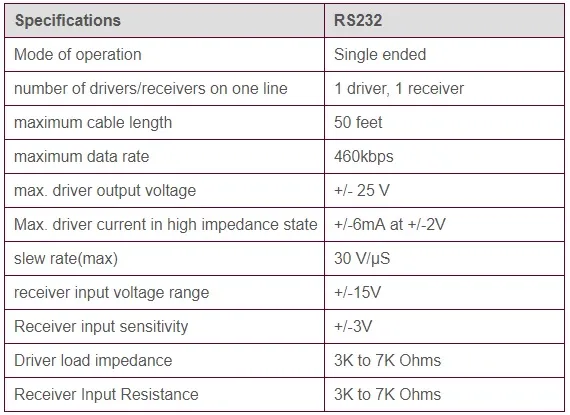
The following table outlines the technical specifications of the serial RS232 interface:
Benefits or Advantages of RS232
- Simplicity and Legacy Support: Due to its simple design, RS232 is supported in a vast number of older, compatible devices.
- Point-to-Point Connection: It’s widely used for direct connections between DTE (Data Terminal Equipment) and DCE (Data Communication Equipment) devices.
- Distance: It can support relatively long distances, up to 50 feet, especially at lower baud rates and with error correction implemented.
- Noise Immunity: The use of +/- 5 Volts or higher for representing binary logic makes RS232 fairly resistant to noise interference.
- Cost-Effective: RS232 is generally a low-cost interface solution.
- Adaptability: Converters and adapters are readily available and affordable for converting RS232 to other interfaces like RS485, USB, or Ethernet.
Drawbacks or Disadvantages of RS232
- System-to-System Communication: Best suited for communication between entire systems, but not ideal for chip-to-chip or chip-to-sensor communication within a device.
- Speed Limitations: Supports lower speeds over longer distances. Higher speeds (e.g., 115200 baud) are only achievable over shorter distances.
- Additional Hardware: Requires separate transceiver chips, adding to the overall system cost.
- Single Master/Slave: Designed for single master and single slave configurations, making it unsuitable for single master-multiple slaves setups.
- Unbalanced Transmission: RS232 uses unbalanced transmission, which can be more susceptible to noise in certain environments compared to balanced transmission methods.
Summary
RS232 remains an important serial communication interface for industrial automation, instrumentation, and embedded systems because of its simplicity and reliability. Its practical advantages continue to support legacy equipment, although modern communication standards provide greater speed and scalability.