
What is Diplexer: Advantages and Disadvantages
Advertisement
A diplexer is a passive RF device that combines or separates signals operating in different frequency bands while sharing a common antenna or transmission line. Its advantages include efficient spectrum utilization and reduced hardware requirements, while its disadvantages include frequency design constraints and insertion loss between connected circuits.
RF Diplexer Selection Guide & Application Note
A diplexer is an RF device that separates two wide bands in the receive direction and combines them in the transmit direction. For an RF diplexer to work satisfactorily, the frequency bands it operates on should be wide apart. It typically uses one Low-Pass Filter (LPF) and one High-Pass Filter (HPF), or two Band-Pass Filters (BPFs) inside to separate the bands.
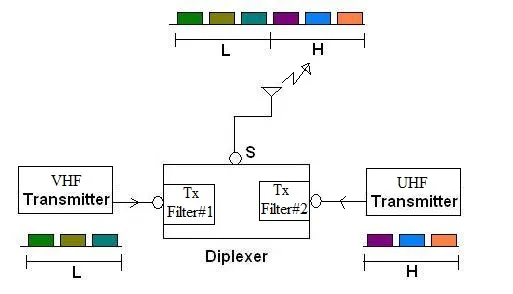
Example application #1: Transmission of VHF and UHF frequencies using a single antenna
Two widely separated bands used for different applications can be combined and transmitted over the same antenna. The diplexer separates out the two different bands in the receive direction.
For example, two frequencies used for different departments, such as police and fire, can be combined and transmitted using the same single radio tower located in the city with the help of an RF diplexer.
The other application is sharing of a single antenna between a transmitter and a receiver.
Technical specifications for RF Diplexer
- Frequency bands : specific frequencies the device needs to handle
- Isolation : Higher isolation between ports to minimize signal leakage
- Insertion loss : Lower insertion loss to reduce signal attenuation
- Power handling capability : The maximum power the device can handle without damage
- Impedance matching : Ensuring compatibility with the system, Typically 50 or 75 Ohm
- Filter Type : The type of filter used in the design (e.g. cavity, ceramic, or SAW filters)
Benefits or Advantages of a Diplexer
- Shared Antenna Usage: Allows two RF systems operating at different frequency bands to use a single antenna, reducing hardware size and cost.
- High Isolation: Provides good isolation between frequency bands, minimizing interference and improving overall system performance.
- Low Insertion Loss: Designed to introduce minimal signal attenuation within the operating bands, helping maintain signal quality.
Drawbacks or Disadvantages of a Diplexer
- The resultant noise figure increases due to the insertion loss of the diplexer.
- Limited Frequency Range: Each diplexer is designed for specific frequency bands and cannot be easily adapted to other frequencies.
- Design Complexity and Cost: High-performance diplexers require precise filter design and manufacturing, increasing complexity and expense.
Summary
Diplexers improve communication system efficiency by allowing multiple frequency bands to share common hardware without significant interference. Their practical advantages reduce equipment complexity and installation costs, although frequency limitations and signal losses remain important design considerations.